Youtheory Ashwagandha 1000 mg (KSM-66): Review
Youtheory · Adaptogen supplement · 4.7/5
By Superfoods Advisor Editors·July 7, 2026
Updated July 7, 2026
Youtheory Ashwagandha 1000 mg review: KSM-66 standardization, dose vs. clinical trials, third-party testing, and what Amazon and Reddit buyers report.
Check price on Amazon on Amazon for Youtheory Ashwagandha 1000 mg (KSM-66), 60 Count (opens in a new tab)Affiliate link. See disclosure.
Summary
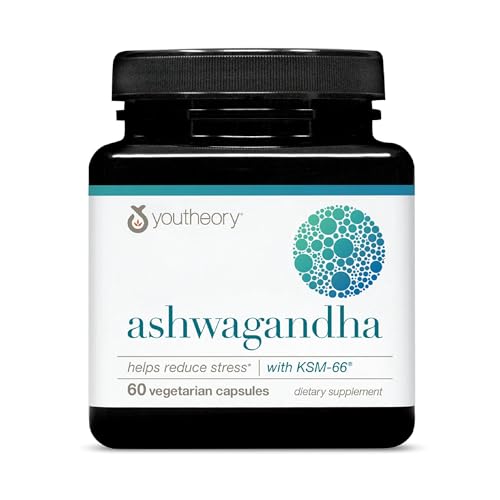
Youtheory Ashwagandha 1000 mg is a good choice on the label evidence, and it is the top-ranked product in our best ashwagandha supplements roundup. Two capsules supply 600 mg of KSM-66, a branded extract standardized to ≥5 percent withanolides, matching the dose in the most-cited stress trials. Its main weakness: the brand says it is not third-party tested.
Its two-capsule, 1,000 mg serving is a blend: 600 mg KSM-66 extract plus 400 mg plain ashwagandha root powder and 20 mg ginger extract (Youtheory supplement facts). The 600 mg of KSM-66 matches the dose used in the most-cited human trials (Chandrasekhar et al. 2012, PubMed; Salve et al. 2019, Cureus).
Nothing on this page diagnoses, treats, prevents, or cures anything; see our medical disclaimer.
What it is
- Extract: KSM-66 (root-only, water-extracted, standardized to ≥5 percent withanolides; see KSM-66 supplier page)
- Dose per serving (2 capsules): 1,000 mg ashwagandha blend (600 mg organic KSM-66 root extract + 400 mg organic root powder), plus 20 mg ginger root extract (Youtheory)
- Other ingredients: Vegetable capsule (hypromellose), microcrystalline cellulose, vegetable magnesium stearate, silicon dioxide
- Format: 60-count bottle (30-day supply at 2 capsules per day)
- Manufacturing: Youtheory’s maker, Nutrawise, is listed by NSF under NSF/ANSI 455-2 (facility-level GMP; this bottle is not NSF Certified for Sport)
Third-party testing and disclosure
Youtheory does not publish per-batch Certificates of Analysis publicly on its Amazon listing, and its own product FAQ states that this product is not third-party tested, relying on in-house quality and purity testing instead (Youtheory). The KSM-66 extract is supplied by Ixoreal Biomed, which publishes specifications for the ingredient. The manufacturer’s facility holds NSF GMP certification, but the bottle carries no Informed Sport or NSF Certified for Sport mark.
Context on the category: In ConsumerLab’s most recent published ashwagandha review, 5 of 13 products passed; the eight that failed contained 7.8–83 percent of the withanolides their labels implied (ConsumerLab, 2024). ConsumerLab also noted that three of the failing products used the same popular branded extract, so a branded ingredient on the label is one signal, not proof of potency.
Amazon customer sentiment
At the time of review, the product carried a strong star average across a large review base. Distilled themes from the review body:
What buyers consistently praise
- Calmer baseline / lower reactivity to daily stress at 3–6 weeks of use
- Improved sleep onset when taken in the evening with food
- Bottle-to-bottle consistency and no obvious “different-feeling batches”
- Price per KSM-66 dose (especially the 180-count Costco bottle)
Common complaints
- Capsule size is medium-large; some users report they are hard to swallow
- Mild GI upset on an empty stomach; food fixes it for most
- A minority of reviewers report no perceptible effect at 4–6 weeks (consistent with the modest effect sizes in the trial literature)
- Occasional reports of a “shift” in libido (both directions); small KSM-66 trials that measured sexual function reported improvements, not decreases (Dongre et al., 2015; Mutha et al., 2025)
Reddit consensus
Discussion of Youtheory on r/Supplements and r/Nootropics is broadly favorable, primarily because it is one of the least expensive ways to hit the trial-standard KSM-66 dose without buying from a boutique brand. Community caveats echo the Amazon data: modest effect sizes, best judged after 6–8 weeks, take with food. Representative threads:
- r/Supplements: general Youtheory brand discussion
- r/Nootropics: KSM-66 dosing threads referencing Youtheory as a low-cost option
We surface these as topical searches rather than picking a single “definitive” thread; sentiment is consistent enough across the last two years of posts that any recent search returns the same picture.
How the dose compares to the trials
| Trial | Extract | Dose | Duration | Endpoint |
|---|---|---|---|---|
| Chandrasekhar 2012 | KSM-66 | 600 mg/day | 60 days | Perceived Stress Scale ↓ |
| Salve 2019 | KSM-66 | 250 or 600 mg/day | 8 weeks | Serum cortisol ↓, sleep ↑ |
| Langade 2019 | KSM-66 | 600 mg/day | 10 weeks | Sleep onset latency ↓, PSQI improved (insomnia patients) |
| Youtheory label | KSM-66 + root powder | 600 mg KSM-66 + 400 mg powder/day (2 caps) | Ongoing | n/a |
The 1,000 mg label figure includes 400 mg of unextracted root powder, so the KSM-66 content of a two-capsule serving (600 mg) matches the trial dose rather than exceeding it. One capsule supplies 300 mg KSM-66, the per-capsule dose used twice daily in these trials.
What we did not test
We did not run our own HPLC assay or a heavy-metal panel. The scoring reflects: (1) match to the trial-standard extract and dose, (2) manufacturer disclosures, (3) Amazon and Reddit sentiment coded against the review methodology in our affiliate disclosure.
Bottom line
For readers who want a widely-available Amazon product that actually uses the extract and dose from the ashwagandha stress and sleep trials, Youtheory Ashwagandha 1000 mg is the best-evidence-to-price capsule we track. Two caveats: (1) the product is not third-party tested (facility-level GMP certification is present), and (2) effect sizes in the underlying literature are modest, and this is not a benzodiazepine substitute.
Safety notes
Ashwagandha has been linked to rare cases of liver injury, documented in case series from Iceland and the US (Björnsson et al., 2020) and from India (Philips et al., 2023). A small trial in people with subclinical hypothyroidism found that ashwagandha raised T3 and T4 levels (Sharma et al., 2018), which matters for anyone with thyroid disease or on thyroid medication. NCCIH advises avoiding ashwagandha during pregnancy and breastfeeding and notes it may interact with some medications (NCCIH); Youtheory’s label likewise says not to use the product if pregnant or nursing. Check with a clinician before starting it alongside medication.
Frequently Asked Questions
Is Youtheory ashwagandha good?
On what can be verified, yes. It is one of the few widely sold capsules that discloses a branded, clinically studied extract, and its 600 mg of KSM-66 per serving matches the trial dose. Effects in the underlying trials are modest, and the brand does not use a third-party lab, so it is a well-matched product rather than a proven one.
Is Youtheory ashwagandha third-party tested?
No. Youtheory’s own product FAQ says this product is not third-party tested and relies on in-house quality and purity testing. Its manufacturer, Nutrawise, is listed by NSF for facility-level GMP, which covers manufacturing practices, not the contents of this bottle. No per-batch certificate of analysis is published on the Amazon listing.
Is Youtheory ashwagandha legit?
Yes, in the sense that the label is specific and traceable. The KSM-66 extract comes from Ixoreal Biomed, which publishes the ingredient’s specifications, the supplement facts are on Youtheory’s site, and the maker holds NSF GMP registration. A branded ingredient is one signal, not proof of potency: ConsumerLab found failing products that used the same popular branded extract.
What are the worst side effects of ashwagandha?
The most serious reported risk is rare liver injury, described in case series from Iceland, the U.S. and India. A small trial also found ashwagandha raised thyroid hormone levels in people with subclinical hypothyroidism. Milder effects such as stomach upset are more common. Stop and seek care if jaundice, dark urine or itching develops, and check with a clinician before combining it with medication.
Related
- Encyclopedia: Ashwagandha: mechanisms, withanolides, trial doses, contraindications
- Roundup: The best ashwagandha supplements
- Guide: How to take ashwagandha for sleep and anxiety
- Science: Adaptogens explained: what the research says
- Policy: Affiliate disclosure
References
Show all 12 referencesShow fewer
- Chandrasekhar K, Kapoor J, Anishetty S. (2012). A prospective, randomized double-blind, placebo-controlled study of safety and efficacy of a high-concentration full-spectrum extract of ashwagandha root in reducing stress and anxiety in adults. Indian Journal of Psychological Medicine.
- Salve J, Pate S, Debnath K, Langade D. (2019). Adaptogenic and anxiolytic effects of ashwagandha root extract in healthy adults: a double-blind, randomized, placebo-controlled clinical study. Cureus.
- Langade D, et al. (2019). Efficacy and safety of ashwagandha (Withania somnifera) root extract in insomnia and anxiety: a double-blind, randomized, placebo-controlled study. Cureus.
- Dongre S, Langade D, Bhattacharyya S. (2015). Efficacy and safety of ashwagandha (Withania somnifera) root extract in improving sexual function in women: a pilot study. BioMed Research International.
- Mutha AS, et al. (2025). Efficacy and safety of eight-week therapy with ashwagandha root extract in improvement of sexual health in healthy men: findings of a prospective, randomized, double-blind, placebo-controlled study. Journal of Ayurveda and Integrative Medicine.
- Björnsson HK, et al. (2020). Ashwagandha-induced liver injury: a case series from Iceland and the US Drug-Induced Liver Injury Network. Liver International.
- Philips CA, et al. (2023). Ashwagandha-induced liver injury: a case series from India and literature review. Hepatology Communications.
- Sharma AK, Basu I, Singh S. (2018). Efficacy and safety of ashwagandha root extract in subclinical hypothyroid patients: a double-blind, randomized placebo-controlled trial. Journal of Alternative and Complementary Medicine.
- National Center for Complementary and Integrative Health. Ashwagandha. NCCIH, National Institutes of Health.
- ConsumerLab. (2024). Ashwagandha supplement findings. ConsumerLab.com.
- ConsumerLab. Ashwagandha supplements review. ConsumerLab.com.
- NSF. NSF/ANSI 455-2 GMP listing: Nutrawise. NSF International.
Read the underlying research in the encyclopedia entry.
By Superfoods Advisor Editors·Published July 7, 2026·Updated July 7, 2026