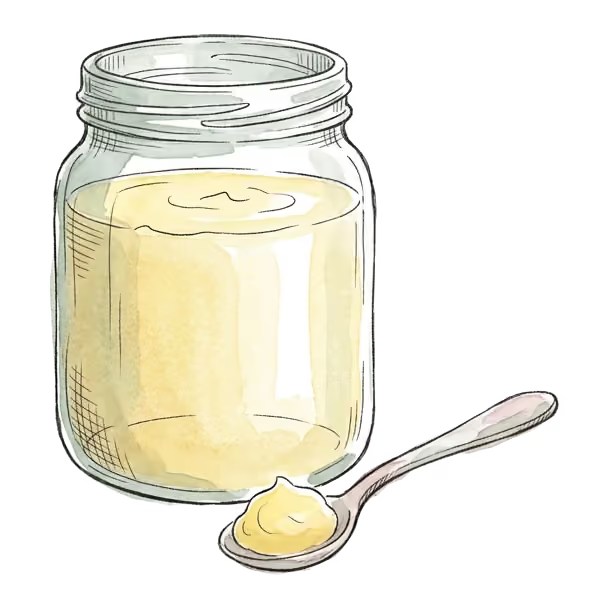
Ghee / Clarified Butter (Bos taurus, milk fat)
Bos taurus · also known as ghee, clarified butter, drawn butter, usli ghee, desi ghee, samneh, smen
By Superfoods Advisor Editors·July 3, 2026
Ghee vs butter: how clarifying removes water, lactose and casein and raises the smoke point, plus ghee benefits, nutrition, storage and saturated fat.
Ghee is clarified butter: cow’s milk butter heated until its water evaporates and its milk solids are strained off, leaving about 99.5% milk fat. Compared with butter, ghee has a higher smoke point (about 250 °C), only trace lactose and casein, and a longer shelf life, but essentially the same saturated fat content.
The milk solids removed are proteins (primarily casein) and carbohydrates (primarily lactose). What remains is a shelf-stable, golden, semi-solid fat with a nutty flavor. The term “ghee” derives from the Sanskrit ghṛta, reflecting the product’s deep roots in South Asian culinary and Ayurvedic medical traditions, where it holds a unique position as both a staple cooking fat and a therapeutic ingredient (Rasayana — a class of preparations believed to rejuvenate and promote longevity).
Clarified butter in various forms appears across food cultures worldwide: beurre clarifié in French classical cuisine, samn in Arab countries, smen (a fermented and aged variant) in Morocco, niter kibbeh (spiced clarified butter) in Ethiopian cooking, and drawn butter in American cooking. Ghee typically refers specifically to the South Asian preparation, which involves a longer, slower heating process that develops Maillard browning of the milk solids before removal, contributing distinctive nutty flavors absent in French-style clarified butter made at lower temperatures.
Evidence at a glance
Active Compounds and Chemical Composition
Ghee is approximately 99.5% fat after complete removal of water and milk solids (USDA FoodData Central, “Butter oil, anhydrous”; Kataria & Singh, 2024). Its fatty acid composition is broadly similar to butter fat but slightly concentrated, and its bioactive minor constituents differ meaningfully from both butter and vegetable oils.
Saturated fatty acids dominate ghee’s fatty acid profile, comprising approximately 62% of total fat in USDA data, roughly equivalent to butter. The primary saturated fatty acids are palmitic acid (C16:0, ~26%), stearic acid (C18:0, ~12%), and myristic acid (C14:0, ~10%). Short-chain fatty acids — including butyric acid (C4:0, ~3%) (USDA FoodData Central) — are present at somewhat higher proportions than in most plant oils but similar to butter.
Butyric acid (butyrate) is arguably the most metabolically interesting specific fatty acid in ghee. As a short-chain fatty acid (SCFA), butyrate is the primary energy substrate for colonocytes (intestinal epithelial cells), supporting colonic epithelial integrity and barrier function. Butyrate also acts as an inhibitor of histone deacetylases (HDACs), enzymes involved in epigenetic gene regulation; HDAC inhibition by butyrate has been associated with anti-inflammatory effects, regulation of intestinal immune responses, and preclinical anti-tumor properties in colonic tissues. Importantly, the butyrate in ghee (or butter) is bound in triglycerides that are digested and absorbed mainly in the stomach and small intestine, so relatively little is thought to reach the colon. The colon’s main butyrate supply comes from gut microbial fermentation of dietary fiber, and ghee’s contribution to colonocyte butyrate is likely small by comparison.
Conjugated Linoleic Acid (CLA) is present in ruminant milk fat at roughly 0.4% of fatty acids in cows on typical confinement diets and about 2.2% in cows fed entirely on pasture (Dhiman et al., 1999). CLA is a group of positional and geometric isomers of linoleic acid (18:2) with the cis-9, trans-11 isomer (also called rumenic acid) predominating in dairy products. In humans, a meta-analysis of 18 placebo-controlled trials found that supplemental CLA at a median 3.2 g/day produced a modest fat loss of about 0.09 kg per week versus placebo (Whigham et al., 2007), with a small (<1%) gain in fat-free mass (Schoeller et al., 2009); anti-tumor effects have been reported mainly in animal models. These supplement doses are far higher than amounts achievable through normal ghee consumption. The applicability of high-dose CLA supplement findings to dietary ghee consumption is unclear.
Vitamins: Ghee carries the fat-soluble vitamins of milk fat. Vitamin A is concentrated during clarification (about 840 µg RAE, or roughly 3,070 IU, per 100 g of anhydrous butter oil), alongside vitamin E (about 2.8 mg/100 g as α-tocopherol) (USDA FoodData Central). Vitamin D content varies with the cows’ diet and season and is not quantified in USDA data. Butter is also among the few dietary sources of vitamin K2 (menaquinones) outside meat, egg yolk, cheese, and fermented foods such as natto (Schurgers & Vermeer, 2000); per-tablespoon amounts are small.
Monounsaturated fatty acids (MUFA): Oleic acid (C18:1) constitutes approximately 25% of ghee’s fat, and total monounsaturates about 29% (USDA FoodData Central), well below olive oil, in which monounsaturates make up most of the fat.
Polyunsaturated fatty acids (PUFA): A small fraction (~4%) consists of linoleic acid (n-6) and alpha-linolenic acid (n-3, higher in grass-fed variants), plus the CLA isomers.
Smoke point: The removal of milk solids and water is what dramatically elevates ghee’s smoke point relative to whole butter. Butter smokes at a much lower temperature because its milk proteins and lactose burn; ghee’s smoke point is approximately 250°C (482°F) (Kataria & Singh, 2024), making it suitable for high-heat sautéing, frying, roasting, and tempering spices (tadka) — applications where whole butter would burn. This is a practical culinary advantage over butter.
Nutritional Profile
Per 1 tablespoon (13 g) of ghee, calculated from USDA FoodData Central “Butter oil, anhydrous” unless noted:
| Component | Amount |
|---|---|
| Calories | 114 kcal |
| Total fat | 12.9 g |
| Saturated fat | 8.0 g (62%) |
| Monounsaturated fat | 3.7 g (29%) |
| Polyunsaturated fat | 0.5 g (4%) |
| CLA | ~0.05–0.27 g (varies with feed; Dhiman et al., 1999) |
| Butyric acid | ~0.4 g |
| Cholesterol | 33 mg |
| Vitamin A | ~110 µg RAE (~400 IU; 12% DV) |
| Vitamin E | ~0.4 mg (2% DV) |
| Lactose | trace (sugars reported as 0 g) |
| Casein | trace at most (largely removed) |
Ghee vs Butter
Nutritionally, ghee is concentrated butterfat; the practical differences come from what clarification removes.
Fat and calories: both are about 62% saturated fat by fatty acid share, with similar butyrate and CLA. Ghee is slightly more concentrated per gram because the water is gone.
Smoke point: butter’s milk proteins and lactose burn at a much lower temperature; ghee smokes at about 250 °C (Kataria & Singh, 2024).
Lactose and casein: ghee carries only traces of either, which may help people with lactose intolerance but does not make it safe for a milk allergy.
Storage and flavor: with almost no water, ghee keeps longer than butter, and the slow South Asian method adds a nutty, browned taste.
Evidence for Purported Benefits
Gut Health (Butyrate and Colonocyte Metabolism)
Evidence:Lab & animal only Rests on butyrate biology and a butyrate-enema trial; no trial has tested eating ghee for gut health.
The butyrate hypothesis for ghee’s gut health benefits rests on well-established colonocyte biology: butyrate is the preferred energy substrate for colonocytes, and adequate butyrate availability supports tight junction integrity, mucus secretion, and mucosal immune tolerance. Butyrate eaten in ghee is largely absorbed before reaching the colon, so the dominant source for colonocytes remains microbial fermentation of dietary fiber (particularly resistant starch and prebiotic fibers), the subject of the dietary fiber and microbiome research review. A small single-blind crossover trial by Scheppach et al. (1992) (Gastroenterology; n = 10 patients with distal ulcerative colitis) found that two weeks of butyrate enemas reduced stool frequency and endoscopic and histological inflammation scores, while placebo did not; this supports an anti-inflammatory colonic role for butyrate but was not a dietary ghee study. No well-powered RCT has specifically examined dietary ghee versus alternative cooking fats on colonic health endpoints in humans.
Lactose and Dairy Protein Tolerance
Evidence:Lab & animal only Inferred from ghee’s near-zero lactose; no trials in people with lactose intolerance.
Ghee contains only trace amounts of lactose (USDA reports 0 g of sugars per 100 g of anhydrous butter oil; USDA FoodData Central). This is a direct consequence of the clarification process removing the carbohydrate fraction alongside milk solids. Because so little lactose remains, ghee is unlikely to cause symptoms in most people with lactose intolerance, although no controlled trials have tested this directly.
Ghee’s casein content is dramatically reduced compared with butter, as casein (a major milk allergen) is a protein removed in the clarification process. However, complete removal depends on the thoroughness of the clarification and straining. Individuals with true IgE-mediated milk protein allergy (as opposed to lactose intolerance) should not assume ghee is safe, as trace milk protein may remain in some products; an allergist can advise.
Cardiovascular Risk: Saturated Fat Debate
Evidence:Limited Results conflict: saturated-fat trial meta-analyses disagree, and South Asian ghee data are confounded.
The principal nutritional controversy surrounding ghee concerns its saturated fat content and cardiovascular risk. The traditional view — supported by metabolic feeding studies — is that diets high in saturated fat raise LDL cholesterol, increasing cardiovascular risk; in a controlled feeding study, higher saturated fat intake tracked with more large LDL particles rather than small dense ones (Dreon et al., 1998). A Cochrane review of randomized trials found that reducing saturated fat lowered combined cardiovascular events by about 17%, with replacement by polyunsaturated fat or carbohydrate appearing useful (Hooper et al., 2020).
However, the precise relationship between saturated fat, LDL particle subfractions, and cardiovascular outcomes has been revisited in recent meta-analyses with more nuanced conclusions. A 2017 meta-analysis by Hamley (Nutrition Journal) found that when only adequately controlled RCTs were pooled, replacing saturated fat with mostly n-6 PUFA had no significant effect on coronary events or mortality, although pooling all trials suggested fewer total coronary events; other meta-analyses have reached different conclusions. Specific saturated fatty acids differ in their LDL effects: stearic acid (C18:0), which is partially converted to oleic acid, is generally considered roughly neutral for LDL cholesterol; butyric acid and short-chain saturated fats are handled differently from long-chain saturated fats in lipoprotein metabolism.
Epidemiological data from South Asia — where ghee has been a traditional dietary fat — do not provide a clear signal, partly because diet patterns, genetics, and other lifestyle variables confound comparisons. At this point, the evidence does not support treating ghee categorically differently from butter with respect to cardiovascular risk: both are high in saturated fat, and both should be considered within the context of overall dietary pattern rather than as isolated items.
Ayurvedic Therapeutic Uses (Rasayana)
Evidence:Insufficient Traditional use; few Ayurvedic ghee preparations have been tested in controlled trials.
Ayurvedic medicine positions ghee as a tridoshic food (balancing all three doshas: vata, pitta, and kapha) and a Rasayana — a rejuvenating substance promoting longevity. Specific Ayurvedic preparations use ghee as a lipophilic carrier for herbal medicines (Medicated ghees or sneha preparations), with the rationale that ghee enhances bioavailability of fat-soluble bioactives from herbs. The carrier vehicle concept has some pharmacokinetic logic for fat-soluble compounds, but few specific Ayurvedic ghee preparations have been evaluated in rigorous clinical trials.
Typical Use and Preparation
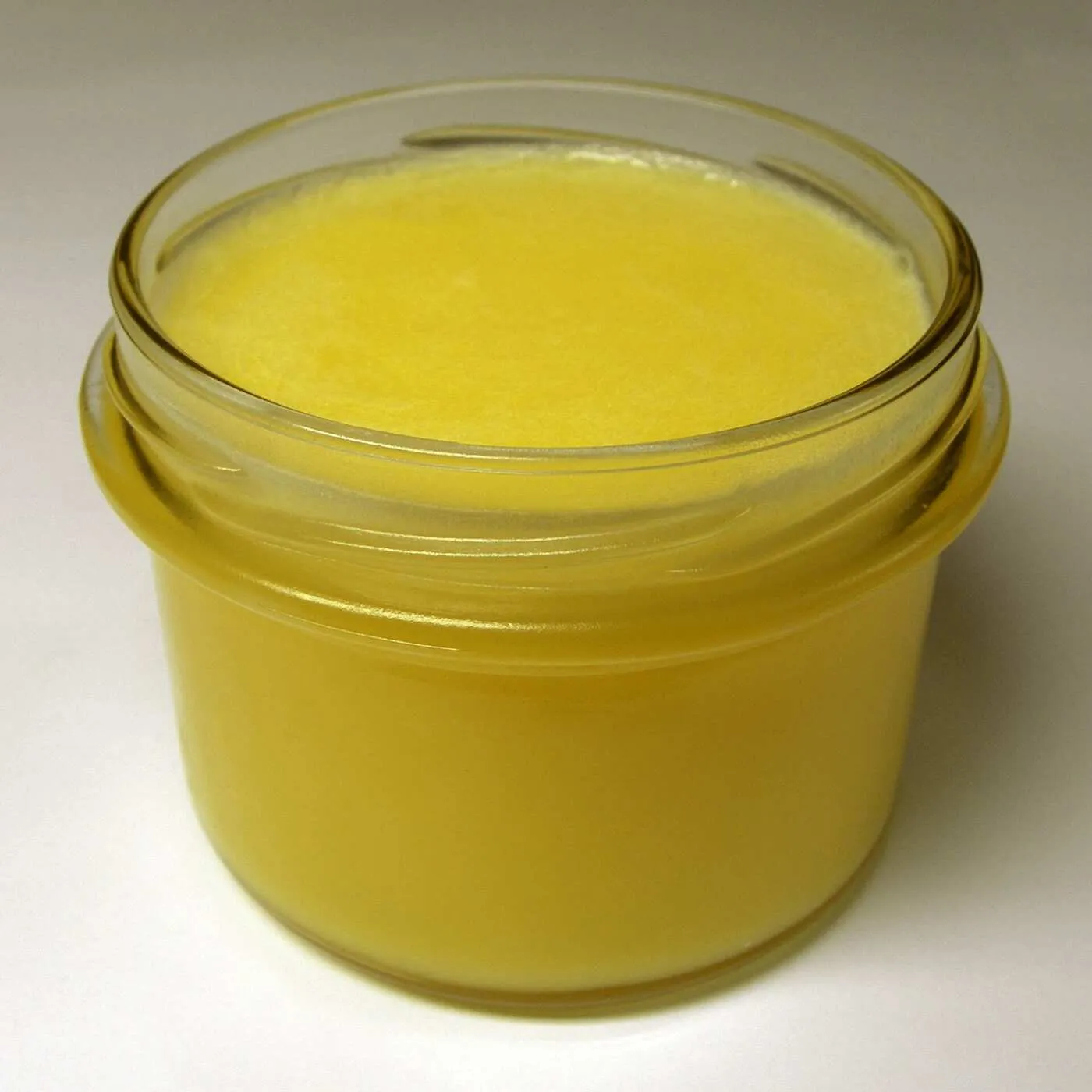 Photo: Rainer Z …, CC BY-SA 3.0, via Wikimedia Commons
Homemade ghee: Produced by melting unsalted butter over low-to-medium heat, allowing water to evaporate and milk solids to settle and lightly brown, then straining through cheesecloth. The process typically takes 20–45 minutes for 500 g of butter. The light browning of milk solids before straining (the traditional South Asian method) produces the characteristic nutty, caramel-like flavor absent in quickly clarified French butter.
Commercial ghee: Available in glass jars; quality and flavor vary significantly. Grass-fed cow ghee commands premium pricing; milk fat from pasture-fed cows contains more CLA (Dhiman et al., 1999). Conventional dairy ghee is otherwise nutritionally similar.
Culinary applications: In South Asian cooking, ghee is used for tempering spices (tadka or chhonk) — the technique of adding whole spices to hot ghee to bloom volatile aromatics before incorporating them into a dish. Its high smoke point (~250°C) makes it suitable for this application, though any fat heated past its smoke point or reused repeatedly degrades. Ghee is also used for roti and bread spreading, enriching biryanis and rice dishes (biryani finishes with a drizzle of ghee), and as a cooking fat for high-heat sautéing.
Shelf stability: Ghee’s near-absence of water and milk proteins makes it substantially more shelf-stable than butter. Properly clarified ghee keeps at room temperature considerably longer than butter, and longer still refrigerated, as its low water content and saturated fat composition slow spoilage and oxidation.
Ghee is used in the saffron-and-jaggery variation of the golden milk recipe.
Safety, Interactions, and Contraindications
Saturated fat and cardiovascular risk: Ghee’s high saturated fat content (approximately 8 g per tablespoon, mostly from palmitic, myristic, and stearic acid) is the primary nutritional concern for individuals at elevated cardiovascular risk. The Dietary Guidelines for Americans, 2025–2030 state that saturated fat should not exceed 10% of total daily calories and advise prioritizing oils with essential fatty acids, such as olive oil, for cooking, while listing butter as another option. This recommendation applies to ghee equivalently to butter. Individuals with familial hypercholesterolemia, established cardiovascular disease, or significantly elevated LDL should discuss cooking fat choices with a dietitian or physician.
Caloric density: At about 114 kcal per tablespoon, ghee is calorically equivalent to other fats and oils. Generous use in cooking (as is common in traditional South Asian preparations) can contribute substantially to daily energy intake.
Dairy allergy (casein): While ghee’s casein content is dramatically reduced versus butter, it is not reliably zero. Ghee is a milk product, and individuals with a diagnosed IgE-mediated milk allergy should avoid it unless their allergist advises otherwise.
Lactose intolerance: Because it contains negligible lactose, ghee is unlikely to cause symptoms in most individuals with lactose intolerance. It is still a dairy product and does not belong in a strictly dairy-free diet; persons with severe reactions should verify product specifications.
Drug interactions: Interactions specific to ghee have not been studied. As with any fatty meal, taking a medication with ghee-rich food can change how much of it is absorbed, so follow label directions on taking medicines with or without food.
Frequently Asked Questions
Is ghee healthier than butter?
Not in any clearly demonstrated way. Ghee has essentially the same saturated fat profile as butter, and the evidence does not support treating the two differently for heart health. Its advantages are practical: a higher smoke point, a longer shelf life and almost no lactose, which may suit people with lactose intolerance.
Is ghee dairy-free?
No. Ghee is made from milk fat, so it is a dairy product even though clarification removes most lactose and casein. People with lactose intolerance often tolerate it, though this has not been tested in trials. Anyone with a diagnosed milk protein allergy should avoid it unless an allergist advises otherwise, because traces of protein can remain.
Does ghee need to be refrigerated?
Usually not. Properly clarified ghee has almost no water or milk protein, so it keeps at room temperature considerably longer than butter, and longer still in the refrigerator. Keep the jar closed, use a clean, dry spoon, and discard it if it smells sour or rancid.
Is ghee good for high-heat cooking?
Yes. With water and milk solids removed, ghee’s smoke point is about 250 °C, high enough for sautéing, frying, roasting and tempering spices. Any fat heated past its smoke point or reused repeatedly degrades, so very high heat and repeated frying are still best avoided.
What are the benefits of ghee?
Most proposed benefits are unproven. Ghee supplies vitamin A (about 110 µg RAE per tablespoon) and small amounts of butyrate and CLA, but the butyrate is mostly absorbed before reaching the colon, and CLA trials used supplement doses far above dietary amounts. Its culinary benefits, heat tolerance and flavor, are the well-established ones.
References
Show all 11 referencesShow fewer
- Scheppach, W., Sommer, H., Kirchner, T., et al. (1992). Effect of butyrate enemas on the colonic mucosa in distal ulcerative colitis. Gastroenterology, 103(1), 51–56.
- Hamley, S. (2017). The effect of replacing saturated fat with mostly n-6 polyunsaturated fat on coronary heart disease: A meta-analysis of randomised controlled trials. Nutrition Journal, 16(1), 30.
- Dhiman, T. R., et al. (1999). Conjugated linoleic acid content of milk from cows fed different diets. Journal of Dairy Science, 82(10), 2146–2156.
- Kataria, D., & Singh, G. (2024). Health benefits of ghee: Review of Ayurveda and modern science perspectives. Journal of Ayurveda and Integrative Medicine, 15(1), 100819.
- Whigham, L. D., Watras, A. C., & Schoeller, D. A. (2007). Efficacy of conjugated linoleic acid for reducing fat mass: a meta-analysis in humans. American Journal of Clinical Nutrition, 85(5), 1203–1211.
- Schoeller, D. A., Watras, A. C., & Whigham, L. D. (2009). A meta-analysis of the effects of conjugated linoleic acid on fat-free mass in humans. Applied Physiology, Nutrition, and Metabolism, 34(5), 975–978.
- Schurgers, L. J., & Vermeer, C. (2000). Determination of phylloquinone and menaquinones in food. Haemostasis, 30(6), 298–307.
- U.S. Department of Agriculture. FoodData Central: Butter oil, anhydrous (FDC 173412).
- U.S. Departments of Agriculture and Health and Human Services. Dietary Guidelines for Americans, 2025–2030.
- Dreon, D. M., Fernstrom, H. A., Campos, H., et al. (1998). Change in dietary saturated fat intake is correlated with change in mass of large low-density-lipoprotein particles in men. American Journal of Clinical Nutrition, 67(5), 828–836.
- Hooper, L., Martin, N., Jimoh, O. F., et al. (2020). Reduction in saturated fat intake for cardiovascular disease. Cochrane Database of Systematic Reviews, 8, CD011737.
Related content

More in Oils & Fats
- Avocado Oil (Persea americana)
Avocado oil vs olive oil: how the two compare on fat profile, smoke point and vitamin E, plus avocado oil benefits, nutrition, uses and side effects.
- Coconut (Cocos nucifera)
Is coconut oil good for you? What trials show on LDL, HDL, weight and MCTs, how it compares with olive and MCT oil, plus coconut flesh, milk and water.
- Dark Chocolate (Theobroma cacao ≥70%)
Is dark chocolate good for you? What trials show for blood pressure, cholesterol and the brain, plus how much a day, caffeine, sugar and heavy metals.
- Extra Virgin Olive Oil (Olea europaea)
Extra virgin olive oil benefits weighed against the evidence: PREDIMED heart data, oleocanthal and other polyphenols, nutrition, daily amounts and safety.
- Raw Cacao (Theobroma cacao)
Cacao vs cocoa: same Theobroma cacao bean, different processing. How roasting and Dutching change flavanols, plus cacao benefits, caffeine and safety.

Curated by Superfoods Advisor Editors·Last updated