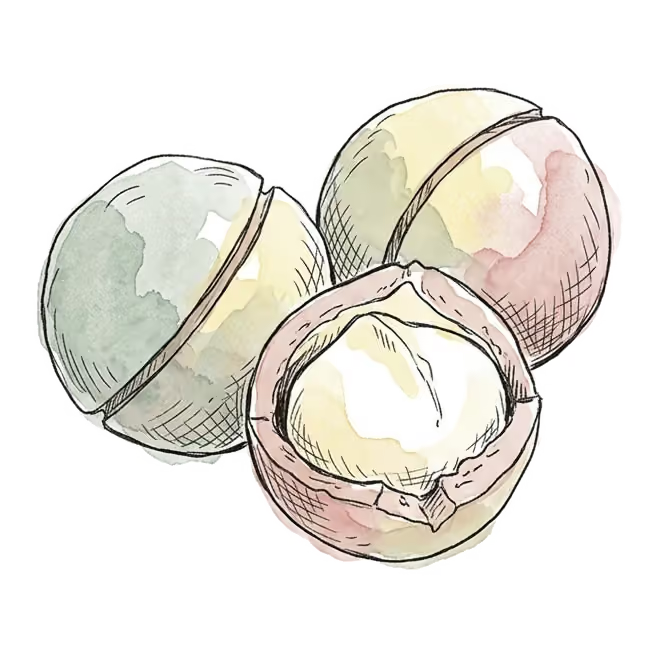
Macadamia Nuts (Macadamia integrifolia / M. tetraphylla)
Macadamia integrifolia / Macadamia tetraphylla · also known as Queensland nut, bush nut, maroochi nut, bauple nut
By Superfoods Advisor Editors·July 3, 2026
Macadamia nuts benefits and nutrition: the fattiest common nut, rich in oleic and palmitoleic acid; cholesterol trials, serving, allergy, dog toxicity.
Macadamia nuts (Macadamia integrifolia and M. tetraphylla, also called Queensland nuts) are Australian tree nuts with the highest fat content of any common nut, about 76 g per 100 g, over 80% of it monounsaturated. A 28 g serving, 10 to 12 nuts, provides about 201 kcal. Small crossover trials found macadamia-rich diets lowered total and LDL cholesterol.
Both species are subtropical evergreen trees in the family Proteaceae, endemic to the rainforests of southeastern Queensland and northeastern New South Wales, Australia. Aboriginal Australians have consumed the nuts — called “boombera” or “kindal kindal” in different regional languages — for thousands of years, incorporating them into ceremonial and everyday food use. European settlement brought the trees to scientific attention in the 1850s; Baron Ferdinand von Mueller and Walter Hill are credited with identifying and naming the genus, which Mueller dedicated to Scottish-Australian physician John Macadam in 1857.
Commercial cultivation began in Hawaii in the early twentieth century following the introduction of macadamia trees from Australia in 1881; Hawaii dominated global production for most of the twentieth century before being surpassed by South Africa, Australia, Kenya, and other producers. Today M. integrifolia (smooth-shelled, commercially dominant) and M. tetraphylla (rough-shelled, slightly sweeter) are the two commercial species, often cultivated as hybrids. Besides their fat content, macadamias stand out for palmitoleic acid (C16:1n-7, sometimes marketed as omega-7), a monounsaturated fatty acid that is rare in plant foods.
Evidence at a glance
Active Compounds
Palmitoleic acid (C16:1n-7, omega-7): The defining nutritional characteristic of macadamia nuts is their significant palmitoleic acid content: about 13 g per 100 g of raw kernels, roughly 18% of total fatty acids and ~3.6 g per 28 g serving (USDA FoodData Central). Palmitoleic acid is a 16-carbon monounsaturated fatty acid that is relatively rare in plant foods — most dietary palmitoleic acid comes from marine sources (fish) or is synthesized endogenously from palmitic acid via delta-9 desaturase. In mice, palmitoleic acid has been described as a “lipokine” — a lipid signaling molecule — that suppressed hepatic lipogenesis and improved insulin sensitivity (Cao et al., 2008). Human evidence is weaker: short-term trials of purified palmitoleic acid have largely reported neutral effects on fasting lipids, glycemic markers, and inflammatory markers (Destaillats et al., 2026, a review by authors employed by a palmitoleic-oil developer).
Oleic acid (C18:1n-9): The most abundant individual fatty acid in macadamia nuts, at about 44 g per 100 g, roughly 60% of total fatty acids (USDA FoodData Central). Oleic acid’s cardiovascular effects are well characterized across multiple nut and oil trials, including attenuation of LDL cholesterol and improvement of endothelial function.
Total monounsaturated fatty acids: Together, palmitoleic and oleic acids give macadamia nuts a MUFA proportion exceeding 80% of total fatty acids — the highest among tree nuts. Total fat content is approximately 76 g per 100 g (USDA FoodData Central), also the highest among commonly consumed tree nuts (exceeding pecans, hazelnuts, and walnuts).
Tocotrienols and tocopherols: Macadamia nuts provide a modest vitamin E complement (~0.5 mg alpha-tocopherol per 100 g, per USDA FoodData Central), meaningfully lower than almonds or hazelnuts. However, small amounts of tocotrienols, the less-studied vitamin E isomers, have been detected in macadamias (Robbins et al., 2011).
Phytosterols: USDA analysis lists about 116 mg phytosterols per 100 g, almost all beta-sitosterol (108 mg) with a little campesterol (8 mg) (USDA FoodData Central). Phytosterols may contribute to modest cholesterol-lowering effects by competing with dietary cholesterol for intestinal absorption.
Thiamine (vitamin B1): Macadamia nuts provide approximately 1.2 mg thiamine per 100 g (~100% DV; USDA FoodData Central), making them an exceptional plant-based source of this B vitamin essential for carbohydrate metabolism and neurological function.
Manganese: At approximately 4.1 mg/100 g (~180% DV; USDA FoodData Central), macadamia nuts are a rich source of manganese, an essential cofactor for mitochondrial superoxide dismutase (MnSOD) and several enzymes involved in gluconeogenesis and amino acid metabolism.
Nutritional Profile
Per 100 g of raw macadamia nuts (USDA FoodData Central, FDC ID 170178):
| Nutrient | Amount | % DV |
|---|---|---|
| Energy | 718 kcal | — |
| Protein | 7.9 g | — |
| Total fat | 75.8 g | — |
| — Saturated fat | 12.1 g | — |
| — Monounsaturated fat | 58.9 g (~82% of fatty acids) | — |
| — Palmitoleic acid (C16:1) | 13.0 g | — |
| — Oleic acid (C18:1) | 43.8 g | — |
| — Polyunsaturated fat | 1.5 g | — |
| — Omega-6 (linoleic) | 1.3 g | — |
| — Omega-3 (ALA) | 0.2 g | — |
| Carbohydrates | 13.8 g | — |
| Dietary fiber | 8.6 g | — |
| Thiamine (B1) | 1.2 mg | 100% |
| Manganese | 4.1 mg | 178% |
| Copper | 0.76 mg | 84% |
| Magnesium | 130 mg | 31% |
| Iron | 3.7 mg | 21% |
| Phosphorus | 188 mg | 15% |
| Potassium | 368 mg | 8% |
| Calcium | 85 mg | 7% |
| Vitamin E (alpha-tocopherol) | 0.5 mg | 4% |
Macadamia nuts’ low PUFA content (~2% of fatty acids) makes them very resistant to oxidative rancidity — their high oleic and palmitoleic acids are considerably less susceptible to oxidation than the linoleic acid or ALA in walnuts or flaxseed.
Evidence for Purported Benefits
Cardiovascular Risk Reduction
Evidence:Moderate Small crossover RCTs consistently lowered total and LDL cholesterol; no long-term event data.
Macadamia nuts have been studied in lipid-lowering trials with generally favorable outcomes. A randomized crossover trial by Curb et al. (Archives of Internal Medicine, 2000) in 30 adults compared three 30-day diets and found that a macadamia nut-based high-monounsaturated-fat diet lowered total and LDL cholesterol relative to a typical American diet, to a similar degree as the lower-fat American Heart Association Step 1 diet. In an uncontrolled before-and-after study, Garg et al. (Journal of Nutrition, 2003) gave 17 hypercholesterolemic men 40–90 g/day of macadamia nuts for 4 weeks and reported 3.0% lower total cholesterol, 5.3% lower LDL cholesterol, and 7.9% higher HDL cholesterol. Griel et al. (Journal of Nutrition, 2008), a 5-week controlled-feeding crossover in 25 mildly hypercholesterolemic adults, found lower total and LDL cholesterol on a macadamia-rich diet than on an average American diet. The proposed mechanism centers on oleic acid substitution for saturated fat (specifically palmitic acid, C16:0, at roughly 8% of macadamia fatty acids per USDA FoodData Central). These diets do not isolate any contribution of palmitoleic acid from the broader monounsaturated-fat matrix (Destaillats et al., 2026).
Insulin Sensitivity and Palmitoleic Acid Signaling
Evidence:Preliminary Mouse data and human observational findings that conflict; no macadamia trials on insulin sensitivity.
Palmitoleic acid’s role as a putative lipokine secreted by adipose tissue was proposed by Cao et al. in a 2008 paper in Cell demonstrating that circulating C16:1n-7 from adipose tissue suppressed hepatic lipogenesis gene expression in mice. Human observational data do not mirror the mouse findings: higher palmitoleic acid in esterified blood lipids often tracks with de novo lipogenesis, hypertriglyceridemia, adiposity, insulin resistance, and fatty liver, while findings for free palmitoleic acid are mixed (Destaillats et al., 2026). This makes it difficult to draw conclusions about the effect of dietary palmitoleic acid from macadamia nuts on metabolic outcomes. The macadamia feeding trials to date have focused on blood lipids rather than insulin sensitivity, so trials with insulin sensitivity as a primary endpoint are needed.
Gut Microbiota and Satiety
Evidence:Insufficient No dedicated macadamia trials on appetite or the microbiome; the idea rests on nutrient profile.
The combination of high fat, high fiber (~8.6 g/100 g), and low carbohydrate in macadamia nuts may plausibly support satiety, as has been proposed for nuts generally. Neither appetite nor microbiome effects have been characterized in dedicated macadamia nut human trials.
Typical Use and Preparation
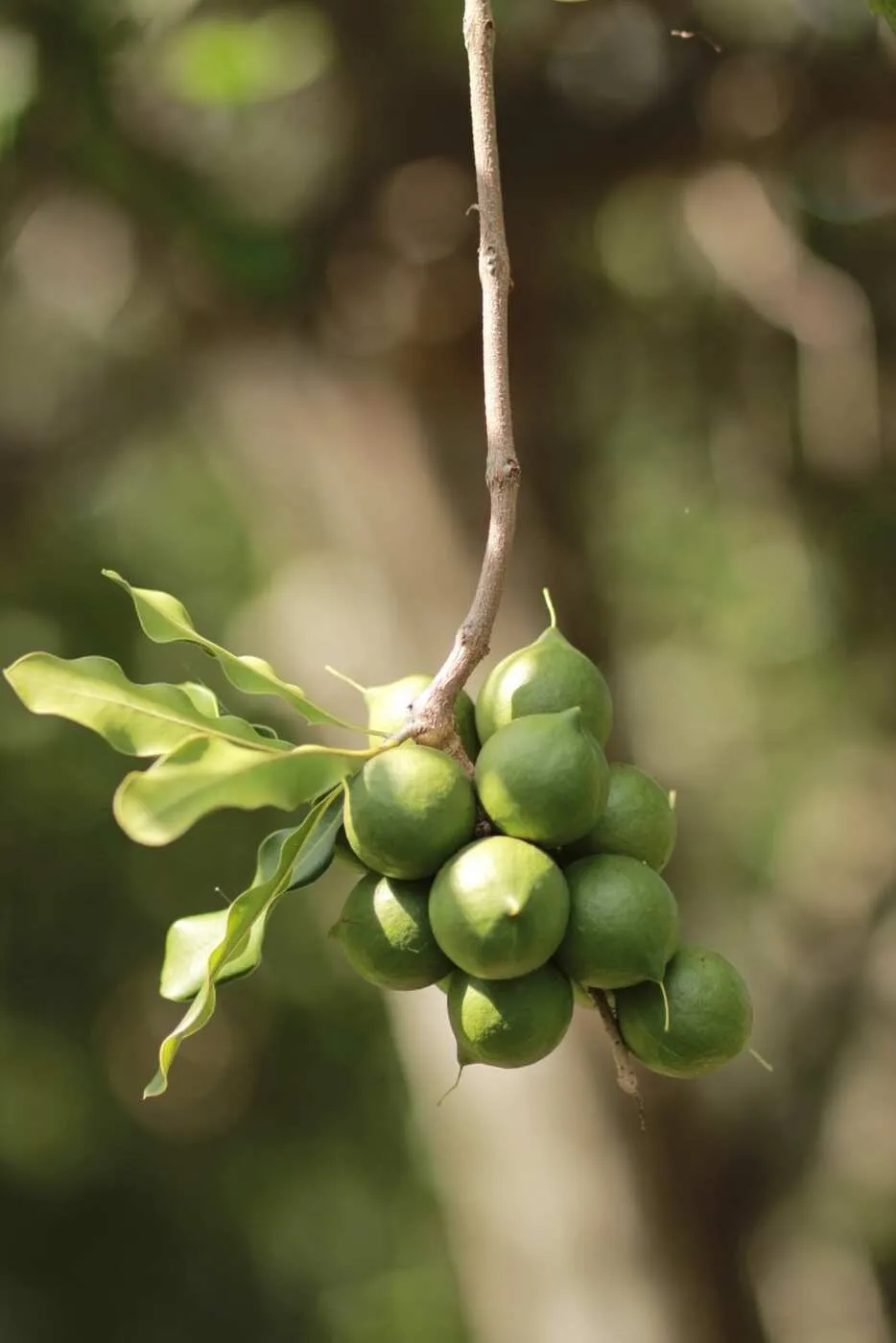 Photo: MorePix, CC BY-SA 3.0, via Wikimedia Commons
Macadamia nuts are consumed raw, roasted, or as macadamia nut oil. They are a prominent ingredient in Hawaiian and Australian cuisines — notably macadamia nut cookies, macadamia-encrusted fish, and chocolate-covered macadamias. Their buttery flavor and high fat content make them popular in ketogenic and low-carbohydrate diet patterns.
Roasting: Macadamia nuts are typically dry-roasted at moderate temperatures, which develops a characteristic buttery-nutty aroma. Their very low PUFA content means oxidative degradation during roasting is considerably less of a concern than with walnuts or sunflower seeds, and the thiamine content — more heat-labile than fat-soluble vitamins — does sustain some reduction with high-heat roasting.
Oil: Cold-pressed macadamia oil is among the most monounsaturated plant oils available (>80% MUFA). It has a relatively high smoke point and is used in sautéing, roasting, and salad dressings.
Storage: The high fat and low water content of macadamia nuts means they keep at room temperature for a limited time; refrigeration or freezer storage is recommended for longer periods to prevent rancidity of the oleic and palmitoleic fractions.
A 28 g serving (~10–12 whole nuts) provides approximately 201 kcal, 2.2 g protein, 21.2 g fat, and 2.4 g fiber (USDA FoodData Central).
The heart-health guide covers the nut trials, including PREDIMED, that frame most research on tree nuts and cardiovascular markers.
Safety, Interactions, and Contraindications
Tree nut allergy: Macadamia nut allergy is less studied than peanut, cashew, or walnut allergy, but it can cause severe systemic reactions. Identified allergens include the vicilin Mac i 1 and the legumin Mac i 2 (Kabasser et al., 2022), with an oleosin and other proteins reported in a small Spanish cohort (Gutiérrez-Díaz et al., 2024). Macadamia nut is classified as a tree nut in mandatory allergen labeling in the US, EU, and Australia. Individuals with tree nut allergies should consult an allergist regarding cross-reactivity risk; macadamia cross-reactivity with other tree nuts has been documented (in the Spanish cohort, with hazelnut but not walnut) but is not systematic.
Toxicity to dogs: Macadamia nuts are toxic to dogs. In a review of 29 cases reported to the ASPCA National Animal Poison Control Center (mean estimated intake 11.7 g/kg body weight), signs included weakness, depression, vomiting, ataxia, tremor, and hyperthermia, with onset within 12 hours in most cases; all dogs in that series, and four experimentally dosed dogs, recovered within 1–2 days. The mechanism of toxicity remains uncharacterized, and macadamia nut toxicosis has so far been reported only in dogs (Cortinovis & Caloni, 2016). Pet owners should store macadamia nuts securely and treat any suspected ingestion by a companion animal as a veterinary emergency.
Caloric density: At 718 kcal/100 g, macadamia nuts are the most calorie-dense tree nut. A 28 g serving (~10–12 nuts) provides 201 kcal — comparable to a small meal or significant snack. Portion awareness is important for individuals managing caloric balance.
Saturated fat content: Despite the dominance of MUFA, macadamia nuts contain approximately 12 g saturated fat per 100 g (principally palmitic acid, C16:0). Individuals following strict saturated fat restrictions should account for this in their dietary pattern.
This entry is for informational purposes only and does not constitute medical advice, diagnosis, or treatment.
Frequently Asked Questions
Are macadamia nuts good for you?
In moderate portions, they can fit a healthy diet. Most of their fat is monounsaturated, and small controlled-feeding trials found macadamia-rich diets lowered total and LDL cholesterol compared with a typical American diet. They also supply thiamine, manganese and fiber. The trade-offs are high calorie density and more saturated fat than most nuts, and long-term outcome data do not exist.
How many macadamia nuts should you eat per day?
A standard serving is 28 g, about 10 to 12 nuts, which supplies roughly 201 kcal. Cholesterol studies used more, from 40 to 90 g a day in one study of hypercholesterolemic men. There is no official upper limit, but because macadamias are the most calorie-dense tree nut, one serving a day is a practical amount for most people managing their weight.
Are macadamia nuts good for people with diabetes?
There is no direct evidence either way. Macadamias are low in carbohydrate (13.8 g per 100 g, with 8.6 g fiber), so they have little immediate effect on blood sugar. Mouse studies suggested palmitoleic acid improves insulin sensitivity, but human observational data conflict and no macadamia trial has measured insulin sensitivity as a main outcome.
Are macadamia nuts toxic to dogs?
Yes. In a review of 29 cases reported to the ASPCA poison control center, dogs that ate macadamia nuts developed weakness, vomiting, tremor, unsteadiness and raised body temperature, usually within 12 hours. All of those dogs recovered within one to two days, but any suspected ingestion should be treated as a veterinary emergency. The toxic mechanism is unknown, and toxicity has been reported only in dogs.
How do macadamia nuts compare with other nuts?
Macadamias have more total fat and calories than any other common nut but less protein (7.9 g per 100 g) and very little omega-3. Walnuts are the better choice for plant omega-3, hazelnuts for vitamin E, and Brazil nuts for selenium. Their low polyunsaturated fat makes macadamias among the most resistant to rancidity.
References
Show all 11 referencesShow fewer
- Garg, M. L., Blake, R. J., & Wills, R. B. H. (2003). Macadamia nut consumption lowers plasma total and LDL cholesterol levels in hypercholesterolemic men. Journal of Nutrition, 133(4), 1060–1063.
- Curb, J. D., Wergowske, G., Dobbs, J. C., Abbott, R. D., & Huang, B. (2000). Serum lipid effects of a high-monounsaturated fat diet based on macadamia nuts. Archives of Internal Medicine, 160(8), 1154–1158.
- Cao, H., Gerhold, K., Mayers, J. R., Wiest, M. M., Watkins, S. M., & Hotamisligil, G. S. (2008). Identification of a lipokine, a lipid hormone linking adipose tissue to systemic metabolism. Cell, 134(6), 933–944.
- Griel, A. E., Cao, Y., Bagshaw, D. D., Cifelli, A. M., Holub, B., & Kris-Etherton, P. M. (2008). A macadamia nut-rich diet reduces total and LDL-cholesterol in mildly hypercholesterolemic men and women. Journal of Nutrition, 138(4), 761–767.
- Hansen, S. R., Buck, W. B., Meerdink, G., & Khan, S. A. (2000). Weakness, tremors, and depression associated with macadamia nuts in dogs. Veterinary and Human Toxicology, 42(1), 18–21.
- USDA FoodData Central. (2019). Nuts, macadamia nuts, raw. FDC ID 170178. U.S. Department of Agriculture.
- Robbins, K. S., Shin, E. C., Shewfelt, R. L., Eitenmiller, R. R., & Pegg, R. B. (2011). Update on the healthful lipid constituents of commercially important tree nuts. Journal of Agricultural and Food Chemistry, 59(22), 12083–12092.
- Destaillats, F., et al. (2026). Palmitoleic (16:1 n-7) acid and metabolic health: integrating observational, clinical, and mechanistic evidence. Frontiers in Nutrition, 13, 1801946.
- Kabasser, S., et al. (2022). Identification of vicilin, legumin and antimicrobial peptide 2a as macadamia nut allergens. Food Chemistry, 370, 131028.
- Gutiérrez-Díaz, G., et al. (2024). Identification of new allergens in macadamia nut and cross-reactivity with other tree nuts in a Spanish cohort. Nutrients, 16(7), 947.
- Cortinovis, C., & Caloni, F. (2016). Household food items toxic to dogs and cats. Frontiers in Veterinary Science, 3, 26.
More in Nuts & Seeds
- Almonds (Prunus dulcis)
Almonds benefits and nutrition: what trials show for LDL cholesterol, blood sugar and weight, plus serving size, vitamin E, oxalate and allergy risks.
- Brazil Nuts (Bertholletia excelsa)
Brazil nuts benefits come down to selenium: one nut can hold 8 to 200 mcg. How many to eat per day, what the research shows, and the toxicity limit.
- Cashews (Anacardium occidentale)
Cashews benefits and nutrition: copper, magnesium and iron per serving, what trials show for blood pressure and blood sugar, and allergy and oxalate risks.
- Chia Seeds (Salvia hispanica)
How to eat chia seeds: soaked, ground or in pudding, with serving size, nutrition and what trials show for blood sugar, blood pressure and weight loss.
- Flaxseed (Linum usitatissimum)
Flaxseed benefits explained: what trials show for blood pressure, cholesterol and constipation, why ground beats whole, daily amounts and side effects.
- Hazelnuts (Corylus avellana)
Hazelnuts benefits and nutrition: oleic acid, vitamin E and folate per serving, what trials show for cholesterol, and how birch-pollen allergy works.


Curated by Superfoods Advisor Editors·Last updated