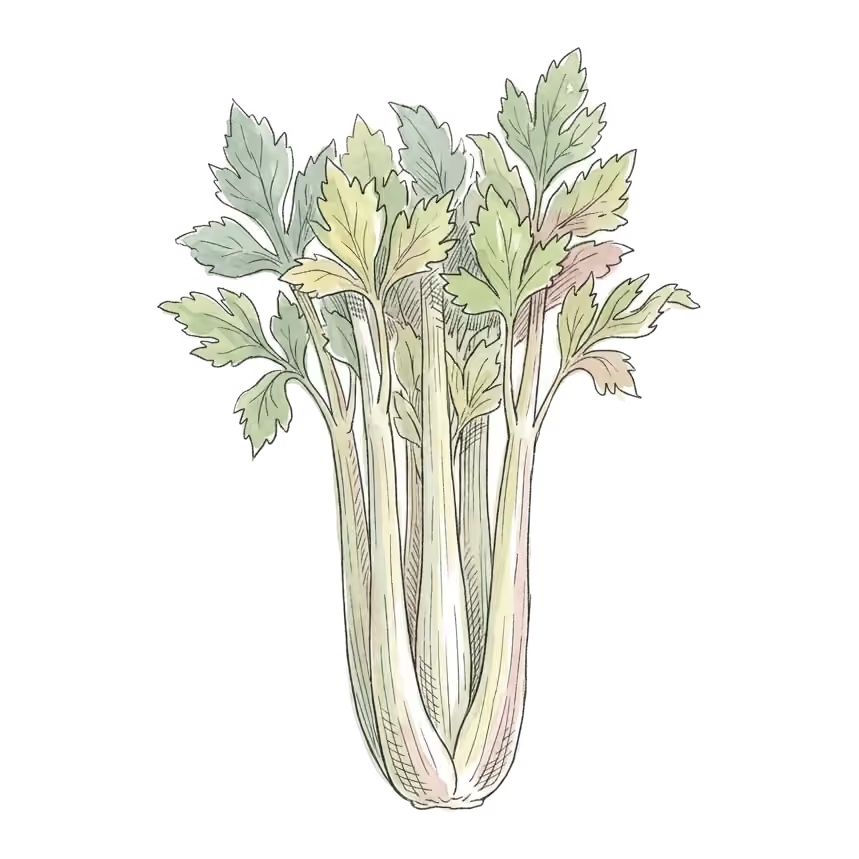
Celery (Apium graveolens)
Apium graveolens · also known as common celery, garden celery, Celery juice, Celery stalk
By Superfoods Advisor Editors·July 3, 2026
Celery juice benefits examined: what apigenin, phthalides and nitrates do in studies, celery nutrition per 100 g, the seed-extract trial, FODMAPs, allergy.
Celery (Apium graveolens) is a low-calorie vegetable in the carrot family (Apiaceae, or Umbelliferae), eaten for its stalks, leaves and seeds. Most claimed celery juice benefits have not been tested directly: the one positive blood-pressure trial used a concentrated seed extract, and evidence for celery’s apigenin and phthalides comes largely from lab and animal studies.
Celery is a marshland plant, and the species most likely originated around the Mediterranean basin, where wild populations grow in salty, moist soils, and it was first cultivated in ancient Egypt and the Roman world mainly as a medicinal herb rather than a food. Solid-stalked celery was first bred in Italy in the 16th century; growers in France and elsewhere in Europe refined it over the 17th to 19th centuries, selecting for plumper, crisper stalks with less of the bitter wild flavour (Lai et al., 2025).
Today celery occupies two distinct functional niches: as a bulk, low-calorie dietary vegetable (a single large stalk of about 64 g provides roughly 9 kcal, per USDA FoodData Central), and as a source of concentrated bioactive compounds in the form of celery seed extract, a separate commercial preparation used in traditional herbal medicine and increasingly evaluated in clinical studies.
Evidence at a glance
Active Compounds
Apigenin (4′,5,7-trihydroxyflavone) is the main flavonoid in celery (Yao et al., 2010). In binding studies apigenin acts as a ligand at the benzodiazepine site of GABA-A receptors, and it had anxiolytic effects in mice (Viola et al., 1995). It also inhibits several cancer cell proliferation pathways in vitro and blocked NF-κB activation in mouse macrophages (Liang et al., 1999). Bioavailability from whole celery is poorly characterized in humans.
Phthalides — a class of bicyclic compounds characteristic of the Apiaceae family — include:
- 3-n-Butylphthalide (3nB): one of the phthalides behind celery’s characteristic aroma and the subject of most blood pressure research. In hypertensive rats, the celery seed extract richest in n-butylphthalide produced the largest blood pressure reduction (Moghadam et al., 2013); its mechanism in humans has not been established.
- Sedanolide and senkyunolide: related phthalides with similar but less-studied profiles.
Luteolin is a related flavone also present in celery (Yao et al., 2010).
Dietary nitrates: Celery is a rich source of inorganic nitrate (NO₃⁻): the widely used Santamaria classification places it among the very-high-nitrate vegetables, above 2,500 mg/kg (250 mg/100 g) fresh weight, though content varies with cultivar and growing conditions (Dodocioiu et al., 2025). Dietary nitrate is reduced to nitrite by salivary bacteria and subsequently converted to nitric oxide (NO) in vivo, supporting vasodilation.
Furanocoumarins: Celery contains psoralen and bergapten — photoactive compounds capable of causing photosensitization dermatitis (see Safety section).
Nutritional Profile (per 100 g raw stalks)
| Nutrient | Amount | % DV (approx.) |
|---|---|---|
| Energy | 14 kcal | — |
| Carbohydrate | 3.0 g | 1% |
| Dietary fiber | 1.6 g | 6% |
| Protein | 0.7 g | 1% |
| Fat | 0.2 g | — |
| Vitamin K1 | 29.3 µg | 24% |
| Vitamin C | 3.1 mg | 3% |
| Folate (B9) | 36 µg | 9% |
| Potassium | 260 mg | 6% |
| Calcium | 40 mg | 3% |
Source: USDA FoodData Central, Celery, raw (FDC ID 169988).
Celery is predominantly water (about 95%), which accounts for its very low energy density. Sodium content is notable relative to other vegetables (80 mg/100 g), which should be considered by individuals on sodium-restricted diets consuming large quantities.
Evidence for Purported Benefits
Blood Pressure Reduction
Evidence:Preliminary One small four-week RCT (52 patients) of celery seed extract, not celery as food, plus rat studies.
The most clinically examined effect of celery is its potential antihypertensive activity, attributed largely to phthalides. In hypertensive rats, Moghadam et al. (Journal of Medicinal Food, 2013) found that celery seed extracts lowered blood pressure, with the largest effect from the extract richest in 3-n-butylphthalide. In humans, a triple-blind, placebo-controlled crossover trial by Shayani Rad et al. (Phytotherapy Research, 2022) gave 52 patients with hypertension 1.34 g/day of celery seed extract or placebo for four weeks; on 24-hour ambulatory monitoring, systolic pressure in the celery phase fell from 141.2 to 130.0 mmHg and diastolic pressure from 92.2 to 84.2 mmHg, with no significant change on placebo. This is a single small, short trial from one research group, and it tested a seed extract rather than celery as a food.
A widely repeated popular-media story about one man’s blood pressure falling after he ate celery daily is an anecdote, not evidence.
Dietary nitrate from celery may provide an additive mechanism: a meta-analysis of dietary nitrate supplementation trials by Siervo et al. (Journal of Nutrition, 2013) of 16 short-term randomized trials (254 participants) found that inorganic nitrate and beetroot juice lowered systolic blood pressure by about 4.4 mmHg, though trials testing celery itself as a nitrate source are lacking.
Anti-inflammatory Activity
Evidence:Lab & animal only Cell studies of apigenin and celery extracts; not confirmed in human trials.
In lipopolysaccharide-stimulated mouse macrophages, apigenin blocked NF-κB activation and suppressed COX-2 and iNOS expression (Liang et al., 1999), and celery leaf extract reduced nitric oxide production about five times more effectively than stalk extract (Lau et al., 2021). These effects have not been confirmed in well-powered human clinical trials. Translation from in vitro concentrations to achievable plasma levels from dietary celery consumption remains uncertain.
Cognitive and Anxiolytic Effects
Evidence:Lab & animal only Rodent studies of apigenin only; no human trials.
Apigenin has been reported to promote adult neurogenesis and memory performance in rodents (summarized in a patent review by Taupin, Expert Opinion on Therapeutic Patents, 2009) and binds the benzodiazepine site of GABA-A receptors, with anxiolytic effects in mice (Viola et al., 1995). No human clinical trials have evaluated apigenin from celery food sources for cognitive or anxiety outcomes.
Diuretic Effects
Evidence:Insufficient Traditional use with some lab work on mechanism; no controlled human trials.
Celery seed has been used as a diuretic in traditional medicine, including by Uyghur practitioners; laboratory work has looked for a mechanism, such as inhibition of urea transporters (Chen et al., 2025), but controlled human trials are not available to confirm or quantify this effect at dietary intake levels.
Typical Use and Preparation
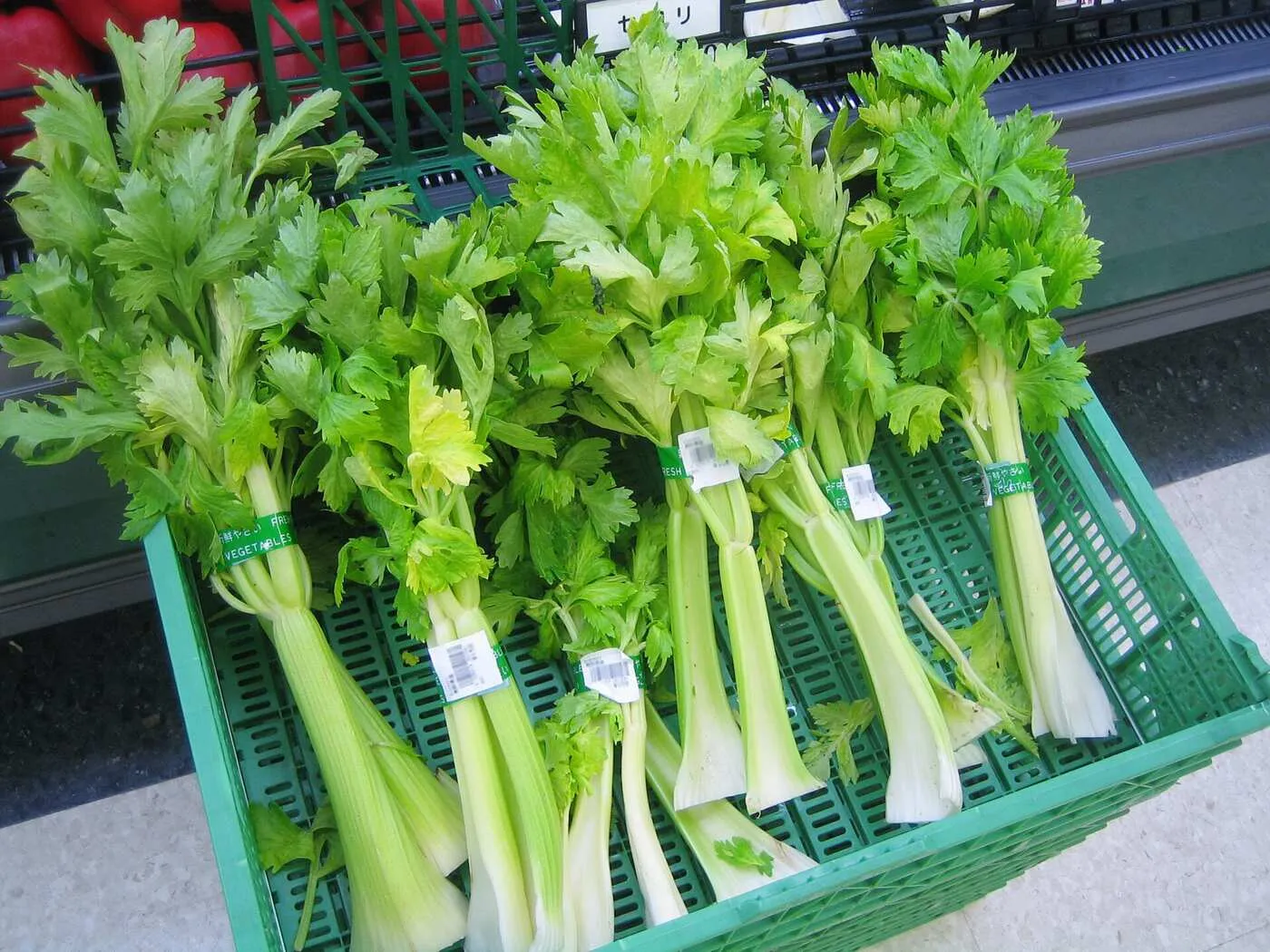 Photo: Lombroso, public domain, via Wikimedia Commons
Celery stalks are consumed raw (as a snack vehicle, in salads, or with dips), cooked as a flavor base in stocks, soups, and stews (as part of the French mirepoix or Italian soffritto), or juiced. Leaves, though more bitter, are suitable for soups or herb blends.
Celery seed and celery seed extract are distinct from whole celery: they concentrate phthalides at levels far beyond what dietary stalk consumption provides, and clinical trials examining blood pressure effects typically use standardized seed extracts rather than food amounts. Claims derived from celery seed extract trials should not be directly extrapolated to consumption of whole celery stalks.
Boiling can leach part of a vegetable’s nitrate into the cooking water (about a quarter in one study of leafy greens; Wu et al., 2021). Juicing concentrates most bioactive compounds relative to the whole stalk but removes fiber. No controlled trial has measured health outcomes from celery juice, so its effects are inferred from the stalk’s composition, not demonstrated. Nitrate-rich beetroot juice, by contrast, has been tested in many small blood-pressure trials.
For the better-studied dietary approaches to blood pressure, including nitrate-rich vegetables, see the heart-health guide.
Safety, Interactions, and Contraindications
Furanocoumarin / Photodermatitis: Celery contains psoralen, bergapten, and other furanocoumarins, which are potent photosensitizers. Handling large quantities of celery (particularly fungus-infected plants, which produce elevated furanocoumarin levels as a stress response) followed by sun exposure can cause phototoxic contact dermatitis — characterized by erythema, edema, and blistering at contact sites. The risk falls mainly on people who handle celery regularly, such as harvest workers (Finkelstein et al., 1994), and on people who eat infected produce or use tanning beds; the furocoumarins in celery eaten as part of a typical diet are generally insufficient to cause a reaction (Pate et al., 2025).
FODMAP content: Celery contains moderate amounts of mannitol, a polyol classified under the FODMAP framework (fermentable oligosaccharides, disaccharides, monosaccharides, and polyols). Monash University’s current data rate celery stalk low-FODMAP in servings up to about 74 g (somewhat under two medium stalks); from 75 g it contains moderate amounts of mannitol, which may trigger symptoms in individuals with irritable bowel syndrome (IBS) sensitive to polyols. Monash revises these thresholds periodically, and earlier versions of its app listed a much smaller low-FODMAP serve.
Allergy and cross-reactivity: Celery is one of the 14 allergens that must be declared on food labels in the European Union (Regulation (EU) No 1169/2011, Annex II); it is not on the mandatory lists in Canada (Health Canada) or Australia and New Zealand (FSANZ). Cross-reactivity occurs with birch pollen (birch-mugwort-celery syndrome), mugwort pollen, and carrot; in patients with challenge-confirmed celery allergy, birch pollen extract blocked IgE binding to all three main IgE-binding celery structures tested, while mugwort extract blocked two of them (Lüttkopf et al., 2000). Reactions range from oral allergy syndrome to anaphylaxis; individuals with pollen allergies should be aware of this risk.
Drug interactions: Celery seed extract may potentiate the effects of antihypertensive medications; concurrent use warrants medical supervision. Celery’s vitamin K content (about 29 µg/100 g, per the table above) is moderate. A sudden large increase in vitamin K intake can weaken warfarin’s effect, so people taking warfarin are generally advised to keep their intake steady rather than avoid such foods (Violi et al., 2016).
Pregnancy: Concentrated celery seed preparations have a traditional reputation as an emmenagogue (menstrual stimulant), and their safety in pregnancy has not been established; they are best avoided during pregnancy.
Frequently Asked Questions
What does celery juice do to your body?
Celery juice is mostly water, with potassium, vitamin K, folate, nitrate and plant compounds such as apigenin; juicing strips out most of the fiber. Beyond hydration and those nutrients, its effects have not been measured: published controlled trials of celery juice are lacking. The blood-pressure reduction seen in one small trial came from a concentrated seed extract, not from juice.
How often should you drink celery juice?
No amount or frequency has been established, because celery juice has not been studied in clinical trials. Several practical limits apply. Juice from more than about 75 g of celery contains enough mannitol to trouble some people with irritable bowel syndrome, and celery carries 80 mg of sodium per 100 g. People taking warfarin or blood-pressure medication should talk to a clinician before drinking it daily.
Does celery juice flatten your stomach?
There is no evidence that celery juice reduces belly fat or bloating. Celery is very low in calories, so swapping it for higher-calorie drinks lowers energy intake, but juicing removes the fiber that makes whole celery filling. Its mannitol, a fermentable polyol, can cause bloating in people sensitive to FODMAPs when portions exceed about 74 g.
Does celery have fiber?
Whole celery has a modest amount: about 1.6 g of dietary fiber per 100 g of raw stalk, roughly 6% of the daily value, for 14 kcal (USDA FoodData Central). Because celery is about 95% water, the fiber per bite is low compared with denser vegetables. Most of it stays behind in the pulp when celery is juiced.
Is celery good for you?
Celery is a useful low-calorie vegetable that adds vitamin K, folate, potassium and nitrate to meals, and it is a traditional flavor base for stocks and soups. Evidence for specific health effects is thin: blood-pressure data come from a seed-extract trial and rat studies, and anti-inflammatory findings come from cell studies. People with pollen allergies should be aware of celery’s allergy risk.
References
Show all 19 referencesShow fewer
- Shayani Rad, M., Moohebati, M., & Mohajeri, S. A. (2022). Effect of celery (Apium graveolens) seed extract on hypertension: A randomized, triple-blind, placebo-controlled, cross-over, clinical trial. Phytotherapy Research, 36(7), 2889–2907.
- Moghadam, M. H., Imenshahidi, M., & Mohajeri, S. A. (2013). Antihypertensive effect of celery seed on rat blood pressure in chronic administration. Journal of Medicinal Food, 16(6), 558–563.
- Siervo, M., et al. (2013). Inorganic nitrate and beetroot juice supplementation reduces blood pressure in adults: a systematic review and meta-analysis. Journal of Nutrition, 143(6), 818–826.
- Taupin, P. (2009). Apigenin and related compounds stimulate adult neurogenesis. Mars, Inc., the Salk Institute for Biological Studies: WO2008147483. Expert Opinion on Therapeutic Patents, 19(4), 523–527.
- Lüttkopf, D., Ballmer-Weber, B. K., Wüthrich, B., & Vieths, S. (2000). Celery allergens in patients with positive double-blind placebo-controlled food challenge. Journal of Allergy and Clinical Immunology, 106(2), 390–399.
- Monash University FODMAP Diet App. Celery (stalk) serving size data, accessed 2026.
- USDA FoodData Central. Celery, raw. FDC ID 169988.
- Dodocioiu, A. M., Buzatu, G. D., & Botu, M. (2025). Nitrates and nitrites in vegetables and the health risk. Foods.
- Lai, E., et al. (2025). Genome of root celery and population genomic analysis reveal the complex breeding history of celery. Plant Biotechnology Journal, 23(3), 946–959.
- Yao, Y., Sang, W., Zhou, M., & Ren, G. (2010). Phenolic composition and antioxidant activities of 11 celery cultivars. Journal of Food Science, 75(1), C9–C13.
- Viola, H., et al. (1995). Apigenin, a component of Matricaria recutita flowers, is a central benzodiazepine receptors-ligand with anxiolytic effects. Planta Medica, 61(3), 213–216.
- Liang, Y. C., et al. (1999). Suppression of inducible cyclooxygenase and inducible nitric oxide synthase by apigenin and related flavonoids in mouse macrophages. Carcinogenesis, 20(10), 1945–1952.
- Lau, H., et al. (2021). Evaluation of anti-inflammatory effects of celery leaf and stem extracts in LPS-induced RAW 264.7 cells using nitric oxide assay and LC-MS based metabolomics. Current Issues in Molecular Biology, 43(3), 1876–1888.
- Chen, G., et al. (2025). Identification and validation of urea transporter B inhibitor from Apium graveolens L. seeds in vitro and in silico. Molecules, 30(7), 1540.
- Wu, S., et al. (2021). Assessment of potential nitrite safety risk of leafy vegetables after domestic cooking. Foods, 10(12), 2953.
- Finkelstein, E., et al. (1994). An outbreak of phytophotodermatitis due to celery. International Journal of Dermatology, 33(2), 116–118.
- Pate, H. F., Hill, K., & McGovern, T. W. (2025). Not as bland as you may think: Celery (Apium graveolens) commonly induces phytophotodermatitis. Cutis, 115(3), E28–E30.
- European Union. Regulation (EU) No 1169/2011 on the provision of food information to consumers, Annex II.
- Violi, F., Lip, G. Y., Pignatelli, P., & Pastori, D. (2016). Interaction between dietary vitamin K intake and anticoagulation by vitamin K antagonists: Is it really true? A systematic review. Medicine, 95(10), e2895.
More in Vegetables
- Artichoke (Cynara cardunculus var. scolymus)
Artichokes benefits explained: prebiotic inulin, cynarin, nutrition per 100 g, and what leaf-extract trials show for cholesterol, digestion and the liver.
- Asparagus (Asparagus officinalis)
Is asparagus good for you? Nutrition per 100 g, including 37% DV folate and 42% vitamin K, its prebiotic fiber, what studies show, and safety notes.
- Beets / Beetroot (Beta vulgaris)
Beet juice benefits explained: how beetroot nitrates lowered systolic blood pressure and aided endurance in trials, beets nutrition per 100 g, and safety.
- Broccoli (Brassica oleracea var. italica)
Is broccoli good for you? Broccoli nutrition per 100 g, including 118% DV vitamin K, how sulforaphane forms, what human studies show, and safety notes.
- Brussels Sprouts (Brassica oleracea var. gemmifera)
Brussels sprouts benefits and nutrition per 100 g (148% DV vitamin K, 94% vitamin C), their glucosinolates, what studies show, gas, and warfarin safety.
- Cabbage (Brassica oleracea var. capitata)
Is cabbage good for you? Cabbage nutrition per 100 g (63% DV vitamin K, 41% vitamin C), red vs green, sauerkraut, what studies show, and thyroid safety.

Curated by Superfoods Advisor Editors·Last updated