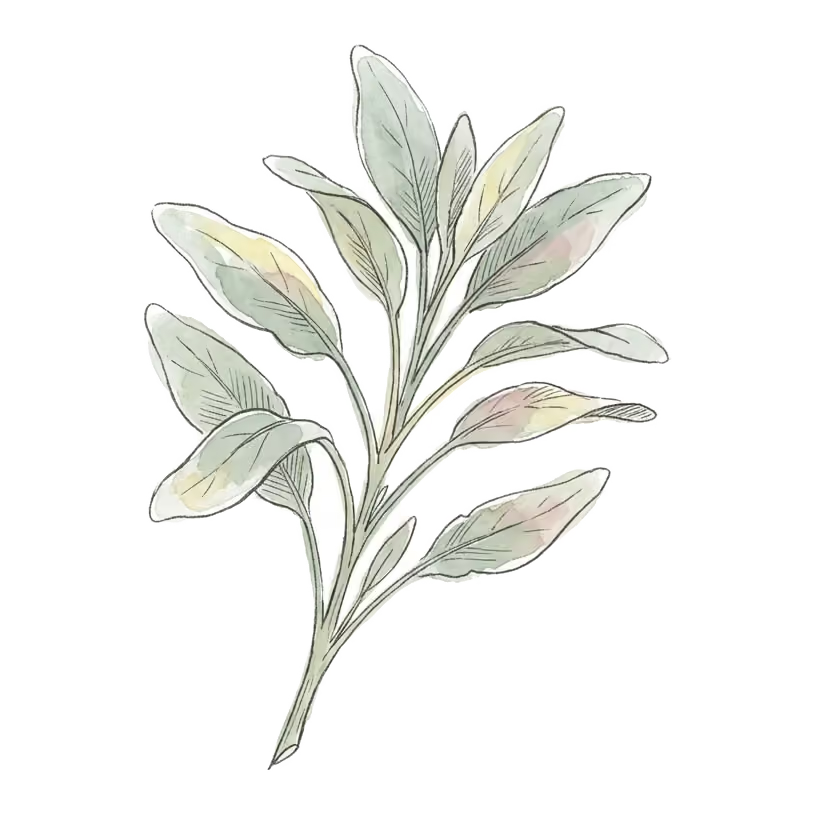
Sage (Salvia officinalis)
Salvia officinalis · also known as sage, common sage, garden sage, culinary sage, Dalmatian sage, true sage
By Superfoods Advisor Editors·July 3, 2026
Sage benefits for memory, hot flashes and oral health: what small trials show, how much sage tea is safe given thujone, and who should avoid it.
Sage (Salvia officinalis), also called common or garden sage, is a culinary herb in the mint family. Its most-studied benefit is memory: small crossover trials found single doses of about 300 to 600 mg of dried leaf or extract improved memory or mood in healthy adults. Its essential oil is rich in thujone, a neurotoxin, so concentrated forms need caution.
The plant is a perennial evergreen native to the northern Mediterranean coast and widely cultivated throughout Europe, North America, and beyond. Its genus name, Salvia, derives from the Latin salvere (“to be well, to be in good health”), a reflection of its long history in European herbal medicine: the adage Cur moriatur homo cui salvia crescit in horto? (“Why should a man die whilst sage grows in his garden?”) circulated in medieval European texts. Sage has been employed variously as a culinary flavoring, a folk remedy for sore throats and menstrual disorders, a strewing herb, and, more recently, as a subject of small clinical trials on cognition.
What distinguishes sage from other well-researched culinary herbs is that its most pharmacologically interesting properties — acetylcholinesterase (AChE) inhibition and cholinergic receptor binding, both shown in vitro — are directly relevant to the cholinergic deficit hypothesis of Alzheimer’s disease, the same mechanism targeted by the major pharmaceutical Alzheimer’s drugs donepezil, rivastigmine, and galantamine. Small randomized controlled trials have reported acute improvements in memory and cognitive performance in healthy adults, and one 16-week trial reported benefits in mild-to-moderate Alzheimer’s disease; a 2014 systematic review judged these effects promising but limited by methodological issues and inconsistent preparations (Miroddi et al., 2014). Sage shares its genus, and much of its chemistry, with rosemary.
Evidence at a glance
Active Compounds
Rosmarinic acid is a caffeic acid ester that is the primary polyphenol in sage and rosemary alike. One HPLC analysis measured about 15 mg of rosmarinic acid per gram of dried S. officinalis leaf, roughly 1.5% by weight (Bandoniene et al., 2005); it contributes substantially to the herb’s antioxidant capacity and anti-inflammatory properties. In laboratory studies it inhibits pro-inflammatory pathways, including NF-κB and 5-lipoxygenase (5-LOX). Human bioavailability data come mainly from related herbs: in a rosemary-tea study, its polyphenols, rosmarinic acid included, were only partially absorbed and were extensively metabolized, largely by gut bacteria (Achour et al., 2021).
Carnosic acid and its oxidative product carnosol are diterpene phenols that serve as potent antioxidants in sage’s lipophilic fraction. Carnosic acid, unlike rosmarinic acid, is primarily relevant at high concentrations found in standardized extracts rather than typical culinary use. In cell and animal studies it activates the Nrf2/ARE pathway, inducing endogenous antioxidant enzymes (heme oxygenase-1, glutathione synthesis enzymes). Carnosic acid’s instability under heat limits its contribution in cooked preparations.
Thujone (α-thujone and β-thujone) is a neurotoxic monoterpene ketone and a major constituent of sage’s essential oil; the European Medicines Agency’s model calculations assumed oils containing 10–60% α-thujone and 4–36% β-thujone, with the proportion depending on chemotype and origin (Walch et al., 2011). α-Thujone blocks GABA-A receptor chloride currents by binding at the non-competitive blocker (picrotoxinin) site, and in mice it produced picrotoxinin-like convulsions (Höld et al., 2000). The critical safety distinction is one of concentration. Dried sage sold as a spice contained about 0.9–1.4 mg thujone per gram in a small German survey (three samples), and aqueous sage tea extracted on average about 30% of the thujone that 60% ethanol recovered, averaging 4.4 mg/L in food-grade teas (Walch et al., 2011). The EU’s Scientific Committee on Food judged the data inadequate to set a tolerable daily intake; the Council of Europe’s TDI of 10 µg/kg body weight/day and the EMA’s 6 mg/day limit for herbal medicinal products are covered under Safety below (EMA, 2012). Sage essential oil concentrates thujone far beyond leaf or tea levels, presents a materially different risk profile, and should not be ingested.
1,8-Cineole (eucalyptol) is a monoterpene ether that, with thujone and camphor, is one of the major constituents of sage essential oil. It weakly inhibits AChE in vitro (Perry et al., 2000) and may contribute to the cognitive effects reported for sage. Cineole is also used as a mucolytic and has been tested as an add-on therapy in COPD (Worth et al., 2009).
Ursolic acid and oleanolic acid are pentacyclic triterpenoids in the lipophilic leaf fraction that demonstrate anti-inflammatory, antitumor, and hepatoprotective effects in preclinical models; they are common across Lamiaceae family herbs.
Flavonoids: Sage contains luteolin, apigenin, hispidulin, and cirsimaritin, which contribute to anti-inflammatory and antioxidant activity.
Nutritional Profile
Per 100 g dried, ground sage (USDA FoodData Central); a typical culinary serving of dried sage is a few grams:
| Component | Amount |
|---|---|
| Calories | 315 kcal |
| Protein | 10.6 g |
| Total fat | 12.8 g |
| Dietary fiber | 40.3 g |
| Vitamin K | 1,710 µg (about 43 µg per 2.5 g serving, ~36% DV) |
| Manganese | 3.1 mg |
| Calcium | 1,650 mg |
| Iron | 28.1 mg |
| Rosmarinic acid | ~15 mg/g in one analysis (Bandoniene et al., 2005) |
Note: At a typical culinary serving (2.5 g dried sage), macronutrient contributions are negligible, but vitamin K and trace mineral contributions become relevant for daily nutrient accounting. Doses used in acute cognitive trials (single doses of roughly 300–600 mg dried leaf or extract) are substantially higher than culinary use.
Evidence for Purported Benefits
Cognitive Function and Memory in Healthy Adults
Evidence:Limited Several small crossover RCTs with mostly positive acute findings; a 2014 systematic review noted methodological limits.
The most compelling clinical evidence for sage addresses acute cognitive effects in healthy adults. A 2003 report by Tildesley et al. (Pharmacology, Biochemistry and Behavior) of two placebo-controlled crossover trials (n=20 and n=24) found that a single 50 µL dose of Spanish sage (S. lavandulaefolia) essential oil significantly improved immediate word recall in young adults. A 2006 study by Kennedy et al. (Neuropsychopharmacology, n=30, crossover) found that single 300 mg and 600 mg doses of dried S. officinalis leaf improved mood ratings, and the 600 mg dose improved performance on a computerized multitasking stressor battery, versus placebo. The 2008 study by Scholey et al. (Psychopharmacology, n=20 adults over 65, crossover) extended these findings to older adults: of four doses of S. officinalis extract tested (167–1,332 mg), the 333 mg dose produced the clearest improvement in secondary memory and attention accuracy.
The proposed mechanistic basis involves cholinesterase inhibition: Kennedy et al. (2006) and Scholey et al. (2008) both confirmed that the S. officinalis extracts they tested inhibited cholinesterase in vitro, Perry et al. (2000) showed that S. lavandulaefolia essential oil and several of its terpenes inhibit human erythrocyte AChE in vitro, and Kennedy et al. (2011, Journal of Psychopharmacology) found that a monoterpenoid S. lavandulaefolia oil was a potent in vitro AChE inhibitor and improved memory and attention in a 36-person crossover trial. In Perry’s assays 1,8-cineole and α-pinene were the most active single terpenes, but none was potent on its own, suggesting synergy among the oil’s constituents. The brain health superfoods guide covers other foods studied for cognition.
Cognitive Function in Alzheimer’s Disease
Evidence:Preliminary One 42-patient RCT with a positive signal; not replicated.
A 2003 RCT by Akhondzadeh et al. (Journal of Clinical Pharmacy and Therapeutics, n=42, 16 weeks) found that 60 drops/day of S. officinalis tincture significantly improved cognitive function on the ADAS-cog and CDR-Sum of Boxes scales relative to placebo in patients with mild-to-moderate Alzheimer’s disease, with a favorable adverse event profile. This is a promising but single, small, insufficiently replicated trial; sage is not a validated Alzheimer’s treatment.
Menopausal Hot Flashes
Evidence:Preliminary One open-label trial of 71 women; no placebo-controlled data.
Sage has traditional use for excessive sweating and menopausal symptoms in European herbal medicine. A small 2011 open-label multicenter trial by Bommer et al. (Advances in Therapy, n=71, 8 weeks) found that a once-daily fresh sage tablet (280 mg) reduced an intensity-weighted hot-flush score by 64% over 8 weeks, and the mean number of daily hot flushes fell each week. How sage might act on hot flushes is unknown; estrogenic activity has been reported for a sage extract in mice (Elgayed et al., 2021), but this has not been shown in humans. The trial’s open-label design (no placebo control) prevents definitive conclusions given the high placebo response rate in menopausal symptom trials.
Antimicrobial and Antiviral Activity
Evidence:Preliminary Lab activity, plus one small mouthwash RCT on plaque bacteria.
Sage has demonstrated antibacterial activity against a range of pathogens — including Staphylococcus aureus, Streptococcus mutans, and several Candida species — in laboratory assays, generally attributed to its essential-oil terpenes. Its use in mouthwashes for oral hygiene has some clinical support: a 2015 double-blind RCT by Beheshti-Rouy et al. (Iranian Journal of Microbiology, n=70 girls aged 11–14) found that 21 days of sage mouthwash significantly reduced Streptococcus mutans colony counts in dental plaque, while a placebo mouthwash did not.
Typical Use and Preparation
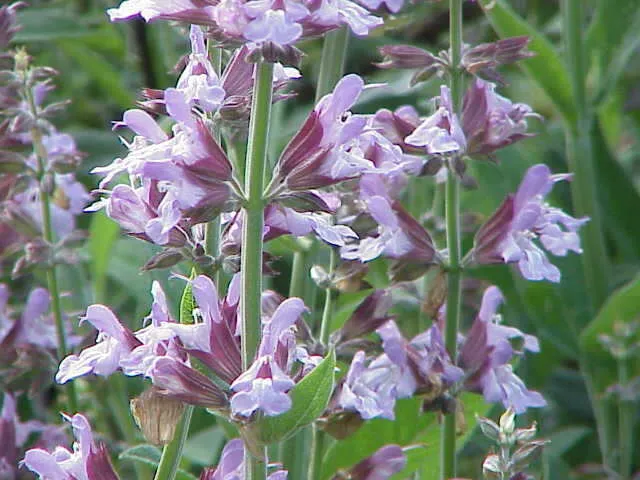 Photo: Kurt Stüber [1], CC BY-SA 3.0, via Wikimedia Commons
Fresh leaves: Used in European (particularly Italian and Central European) cooking with roasted meats — most famously in Italian saltimbocca (veal with prosciutto and sage) and in sage-butter sauces for pasta. Fresh sage has a more complex flavor than dried, with greater volatile oil content.
Dried sage: More pungent and concentrated than fresh; used in stuffing mixtures, sausages, and spice blends. A common recommendation is 1:3 conversion (1 teaspoon dried = 3 teaspoons fresh). The EMA sage-leaf monograph records no case of overdose from sage leaves (EMA monograph, 2016), but because dried leaf can carry roughly 1 mg thujone per gram, daily heavy use warrants awareness.
Sage tea: Brewed from 1–2 g dried sage leaves in 150 mL boiling water, the herbal-tea posology in the EMA herbal monograph; thujone extraction levels off after about 5 minutes of steeping (Walch et al., 2011). Sage tea is a traditional remedy in European herbal medicine for sore throat, oral inflammation, and excessive sweating, and delivers rosmarinic acid and cineole while providing substantially less thujone than concentrated tinctures or essential oil preparations.
Standardized extracts (clinical use): Acute cognitive trials have used single doses of roughly 300–600 mg of dried sage leaf or standardized extract. By leaf weight these doses are comparable to a modest culinary serving, but extracts and tinctures can concentrate thujone well beyond leaf levels depending on the solvent used, so a product’s specified thujone content should be checked against the EMA’s 6 mg/day limit.
Sage essential oil: Not for internal use. Concentrated essential oil delivers far more thujone than leaf or tea, a level that presents genuine neurotoxic risk upon ingestion, particularly in children, in whom accidental ingestion of sage oil has caused generalized seizures (Halicioglu et al., 2011); the EMA has concluded that the benefits of sage essential oil do not outweigh its risks (EMA, 2012). It is used externally in aromatherapy and topical preparations.
Culinary herbs such as sage fit alongside the spices and staples in the anti-inflammatory pantry guide.
Safety, Side Effects, and Interactions
Sage used as a seasoning is safe for most people; the risks come from thujone in tinctures, essential oil and very large daily quantities.
Thujone neurotoxicity at high doses: The primary safety concern specific to sage is thujone, concentrated in the essential oil. The EMA sage-leaf monograph reports no case of overdose from sage leaves and lists sage tea as a traditional herbal medicine for adults. High-dose tinctures, essential oil ingestion, and long-term very high supplement doses carry meaningful risk of seizure and other neurological effects due to GABA-A receptor antagonism. The tolerable daily intake of 10 µg/kg/day set by the Council of Europe, cited in the European Medicines Agency’s 2012 public statement on thujone, equates to approximately 700 µg/day for a 70 kg adult; the EMA recommends 6 mg/day as the upper limit of thujone exposure from herbal medicinal products, and its sage-leaf monograph notes that sage oil equivalent to more than 15 g of leaf has been reported to cause tachycardia, vertigo and epileptiform convulsions (EMA monograph, 2016). Measured dried spice samples contained about 0.9–1.4 mg thujone per gram, so a 2.5 g serving could supply roughly 2–3.5 mg — above the Council of Europe’s long-term dietary TDI if eaten daily, though within the range the EMA considers acceptable for short-term medicinal use. Walch et al. (2011) estimated that up to about six cups a day of average food-grade sage tea, or three of medicinal sage tea, would stay under the EMA limit.
Pregnancy and lactation — avoid medicinal use: Sage is traditionally regarded as an emmenagogue, but reproductive toxicity tests have not been performed and safety in pregnancy and lactation has not been established; the EMA monograph therefore does not recommend medicinal sage during pregnancy or breastfeeding, nor in children and adolescents under 18 (EMA monograph, 2016), and the EMA’s thujone statement advises minimizing thujone-containing products in these groups. The EMA guidance addresses medicinal products rather than sage used as a seasoning; medicinal preparations, large daily quantities of sage tea, and any sage essential oil should be avoided.
Diabetes and blood glucose: Sage extracts lower blood glucose in animal models. In a three-month randomized placebo-controlled trial in 80 hyperlipidemic type 2 diabetic patients, 500 mg of sage leaf extract three times daily lowered fasting glucose and HbA1c relative to placebo (Kianbakht & Dabaghian, 2013); a non-randomized pilot in six healthy women found four weeks of sage tea had no effect on plasma glucose (Sá et al., 2009). The evidence is limited and needs replication. Individuals on antidiabetic medications should monitor blood glucose when initiating sage supplementation to avoid compounding hypoglycemia.
Seizure disorders (precautionary): The EMA sage-leaf monograph lists no epilepsy contraindication (only hypersensitivity) (EMA monograph, 2016). As a precaution, because thujone is a GABA-A antagonist and sage-oil overdose has caused convulsions, individuals with epilepsy or on anticonvulsant medications may prefer to avoid high-dose sage preparations and should discuss supplements with their clinician.
Cholinergic drug interactions: No interactions are reported in the EMA monograph, but sage’s in vitro AChE inhibition suggests a theoretical additive interaction with pharmaceutical cholinesterase inhibitors (donepezil, rivastigmine, galantamine) used in Alzheimer’s treatment. Combined use may increase cholinergic side effects (nausea, diarrhea, bradycardia). Individuals on these medications should consult a neurologist before using sage supplements.
Hormonal interactions: A sage extract showed estrogenic (uterotrophic) activity in immature female mice (Elgayed et al., 2021). Whether this is relevant to people with hormone-sensitive conditions or on hormone therapy is unknown, since no human data exist; those individuals may reasonably discuss sage supplements with their clinician.
Frequently Asked Questions
Is sage good for you?
As a seasoning, sage adds flavor along with rosmarinic acid and, per gram of dried leaf, notable vitamin K. Small trials suggest single doses of sage leaf or extract can briefly improve memory and mood, and a sage mouthwash reduced plaque bacteria in one trial. These effects rest on limited evidence, and sage is not a proven treatment for any condition.
How much sage tea is safe to drink?
The EMA monograph’s herbal-tea dose is 1 to 2 g of dried leaf in 150 mL of boiling water. Measuring thujone in commercial teas, Walch and colleagues estimated that up to about six cups a day of average food-grade sage tea, or three cups of medicinal sage tea, would stay under the EMA’s 6 mg limit. Medicinal use is not recommended in pregnancy or under 18.
How much sage is too much?
The concern is thujone. Dried sage carries roughly 1 mg per gram, so a daily 2.5 g serving exceeds the Council of Europe’s long-term intake guide of about 700 µg for a 70 kg adult, though it is within the EMA’s short-term medicinal limit. Sage oil equivalent to more than 15 g of leaf has caused rapid heartbeat, vertigo and convulsions.
Does sage help with hot flashes?
There is preliminary evidence. In an open-label trial of 71 women, one 280 mg fresh sage tablet a day for eight weeks reduced an intensity-weighted hot-flush score by 64%. Without a placebo group, the result cannot be separated from the large placebo response typical of menopause trials. Women considering it should discuss it with their clinician, especially with a hormone-sensitive condition.
Is culinary sage the same as white sage used for cleansing?
No. The sage covered here is Salvia officinalis, the kitchen herb. The white sage sold in smudging or “cleansing” bundles is generally identified as Salvia apiana, a different plant, though bundle labels do not always name the species. The research on this page concerns common sage taken by mouth, not burning any sage.
References
Show all 20 referencesShow fewer
- Kennedy, D. O., et al. (2006). Effects of cholinesterase inhibiting sage (Salvia officinalis) on mood, anxiety, and performance on a psychological stressor battery. Neuropsychopharmacology, 31(4), 845–852.
- Scholey, A. B., et al. (2008). An extract of Salvia (sage) with anticholinesterase properties improves memory and attention in healthy older volunteers. Psychopharmacology, 198(1), 127–139.
- Akhondzadeh, S., et al. (2003). Salvia officinalis extract in the treatment of patients with mild to moderate Alzheimer’s disease: A double blind, randomized and placebo-controlled trial. Journal of Clinical Pharmacy and Therapeutics, 28(1), 53–59.
- Bommer, S., et al. (2011). First time proof of sage’s tolerability and efficacy in menopausal women with hot flushes. Advances in Therapy, 28(6), 490–500.
- European Medicines Agency, Committee on Herbal Medicinal Products (HMPC). (2012). Public statement on the use of herbal medicinal products containing thujone. EMA/HMPC/732886/2010 Rev.1.
- Perry, N. S., et al. (2000). In-vitro inhibition of human erythrocyte acetylcholinesterase by Salvia lavandulaefolia essential oil and constituent terpenes. Journal of Pharmacy and Pharmacology, 52(7), 895–902.
- Miroddi, M., et al. (2014). Systematic review of clinical trials assessing pharmacological properties of Salvia species on memory, cognitive impairment and Alzheimer’s disease. CNS Neuroscience and Therapeutics, 20(6), 485–495.
- Tildesley, N. T., Kennedy, D. O., Perry, E. K., et al. (2003). Salvia lavandulaefolia (Spanish sage) enhances memory in healthy young volunteers. Pharmacology, Biochemistry and Behavior, 75(3), 669–674.
- Kennedy, D. O., Dodd, F. L., Robertson, B. C., et al. (2011). Monoterpenoid extract of sage (Salvia lavandulaefolia) with cholinesterase inhibiting properties improves cognitive performance and mood in healthy adults. Journal of Psychopharmacology, 25(8), 1088–1100.
- Beheshti-Rouy, M., et al. (2015). The antibacterial effect of sage extract (Salvia officinalis) mouthwash against Streptococcus mutans in dental plaque: a randomized clinical trial. Iranian Journal of Microbiology, 7(3), 173–177.
- Bandoniene, D., Murkovic, M., & Venskutonis, P. R. (2005). Determination of rosmarinic acid in sage and borage leaves by high-performance liquid chromatography with different detection methods. Journal of Chromatographic Science, 43(7), 372–376.
- Walch, S. G., Kuballa, T., Stühlinger, W., & Lachenmeier, D. W. (2011). Determination of the biologically active flavour substances thujone and camphor in foods and medicines containing sage (Salvia officinalis L.). Chemistry Central Journal, 5, 44.
- European Medicines Agency, HMPC. (2016). European Union herbal monograph on Salvia officinalis L., folium. EMA/HMPC/277152/2015.
- Kianbakht, S., & Dabaghian, F. H. (2013). Improved glycemic control and lipid profile in hyperlipidemic type 2 diabetic patients consuming Salvia officinalis L. leaf extract: a randomized placebo-controlled clinical trial. Complementary Therapies in Medicine, 21(5), 441–446.
- Sá, C. M., et al. (2009). Sage tea drinking improves lipid profile and antioxidant defences in humans. International Journal of Molecular Sciences, 10(9), 3937.
- Elgayed, S. H., et al. (2021). Estrogenic effect of Salvia officinalis extract on reproductive function of female mice and identification of its phenolic content. Combinatorial Chemistry & High Throughput Screening.
- Höld, K. M., Sirisoma, N. S., Ikeda, T., Narahashi, T., & Casida, J. E. (2000). Alpha-thujone (the active component of absinthe): gamma-aminobutyric acid type A receptor modulation and metabolic detoxification. Proceedings of the National Academy of Sciences, 97(8), 3826–3831.
- Achour, M., et al. (2021). Bioavailability and nutrikinetics of rosemary tea phenolic compounds in humans. Food Research International, 139, 109815.
- Worth, H., Schacher, C., & Dethlefsen, U. (2009). Concomitant therapy with Cineole (Eucalyptole) reduces exacerbations in COPD: a placebo-controlled double-blind trial. Respiratory Research, 10, 69.
- Halicioglu, O., Astarcioglu, G., Yaprak, I., & Aydinlioglu, H. (2011). Toxicity of Salvia officinalis in a newborn and a child: an alarming report. Pediatric Neurology, 45(4), 259–260.
More in Roots & Herbs
- Ashwagandha (Withania somnifera)
Ashwagandha side effects, who should avoid it, and drug interactions, plus what trials show for stress, sleep and strength at clinical doses.
- Basil (Ocimum basilicum)
Basil benefits: what lab and human studies show, vitamin K per serving, sweet basil vs holy basil, and the estragole and warfarin cautions.
- Black Pepper (Piper nigrum)
Black pepper benefits: how piperine raises absorption of curcumin and some drugs, what human studies show, side effects, and drug interactions.
- Cilantro / Coriander (Coriandrum sativum)
Cilantro vs parsley: how the two herbs differ in flavor, vitamin K and vitamin C, plus what the evidence says about cilantro benefits and safety.
- Cinnamon (Cinnamomum verum / C. cassia)
Ceylon cinnamon vs cassia: coumarin levels and liver risk, how much is safe per day, and what trials show for blood sugar and cholesterol.
- Garlic (Allium sativum)
Garlic benefits for blood pressure, cholesterol and colds: what trials show, how much raw garlic or supplement they used, and bleeding risks.

Curated by Superfoods Advisor Editors·Last updated